
Imagine trying to write a tiny letter on a grain of rice. Not with a miniature pen, but with an ordinary pencil. Every movement would need to be incredibly controlled. A slight tremor could turn a precise line into an unreadable mark.
Now imagine being asked to perform that task while repairing a blood vessel narrower than one millimetre.
This is the extraordinary challenge faced by microsurgeons every day. Their work involves manipulating structures so small that even the slightest involuntary movement can make a difference.
Sony believes robotics could help overcome some of these limitations.
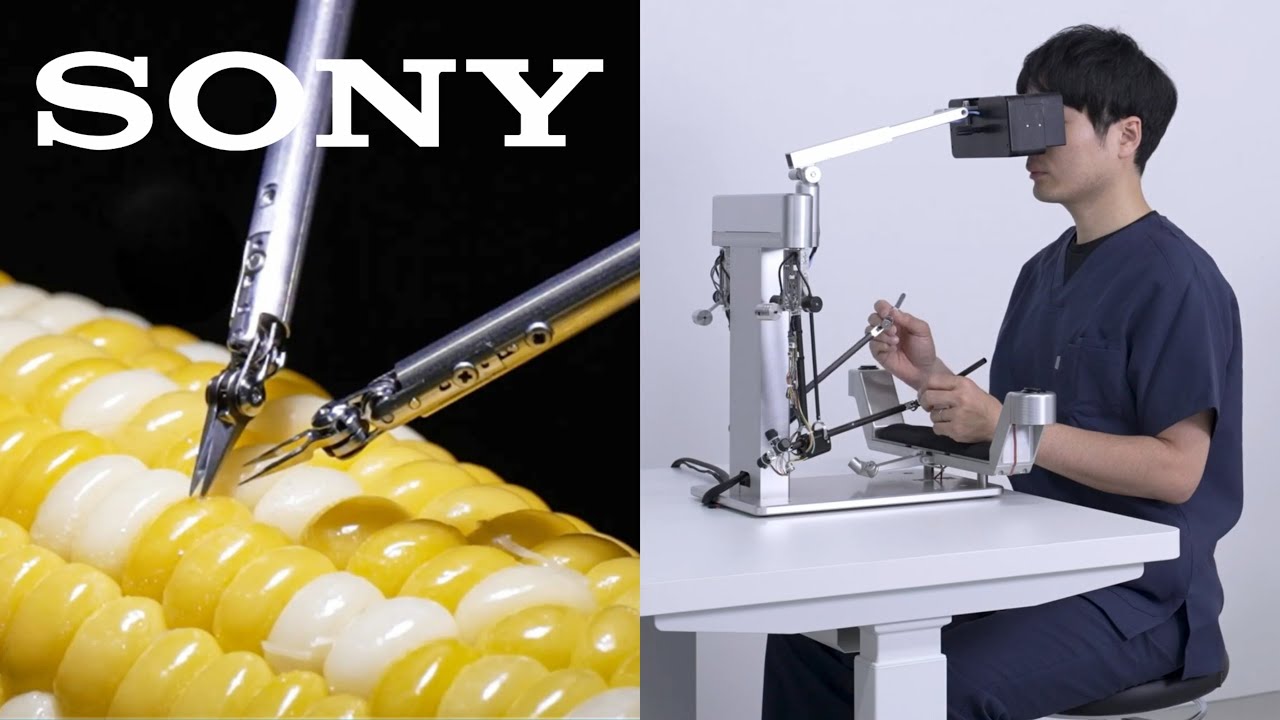
The Japanese technology company has developed a Microsurgery Assistance Robot, an experimental system designed to translate a surgeon’s natural hand movements into much smaller, highly controlled movements.
Its ambition goes beyond making surgery more precise. It explores a potentially transformative idea: what if advanced microsurgical procedures could become accessible to a much larger number of medical professionals and patients?
Musumeci Online – The Podcast. It is perfect for driving, commuting, or waiting in line!
1. The challenge: Operating at the limits of human dexterity
Microsurgery is a specialised surgical discipline that allows doctors to operate on extremely small anatomical structures, including blood vessels, nerves and lymphatic vessels.
Using operating microscopes and specialised instruments, surgeons can connect tiny vessels, repair damaged nerves and reconstruct tissues that would otherwise be extremely difficult to treat.
Within this field, an even more demanding discipline is known as supermicrosurgery.
It generally involves operating on blood vessels and nerves measuring between 0.3 and 0.8 millimetres in diameter.
To understand the scale, consider that a typical sheet of printer paper is approximately 0.1 millimetres thick. A blood vessel measuring 0.6 millimetres is therefore only about as wide as six sheets of paper stacked together.
At this scale, the human hand faces several natural limitations:
- Physiological tremor: even healthy hands make tiny involuntary movements.
- Physical fatigue: maintaining an extremely precise position for long periods is demanding.
- Limited dexterity: the size and geometry of conventional surgical instruments restrict movement.
- Specialist training: mastering these procedures can take months or years of dedicated practice.
The result is a highly specialised field in which access to treatment can depend on the availability of experienced surgeons and suitably equipped medical facilities.
This is the problem Sony wants to address.
2. Sony’s idea: Making human movements smaller and more precise
The fundamental principle behind Sony’s robot is surprisingly intuitive.
Instead of asking a surgeon to control a microscopic instrument directly, the system allows them to operate a dedicated console.
Their hand and finger movements are captured by a sensitive control device and reproduced by robotic instruments at a reduced scale.
This technique is known as motion scaling.
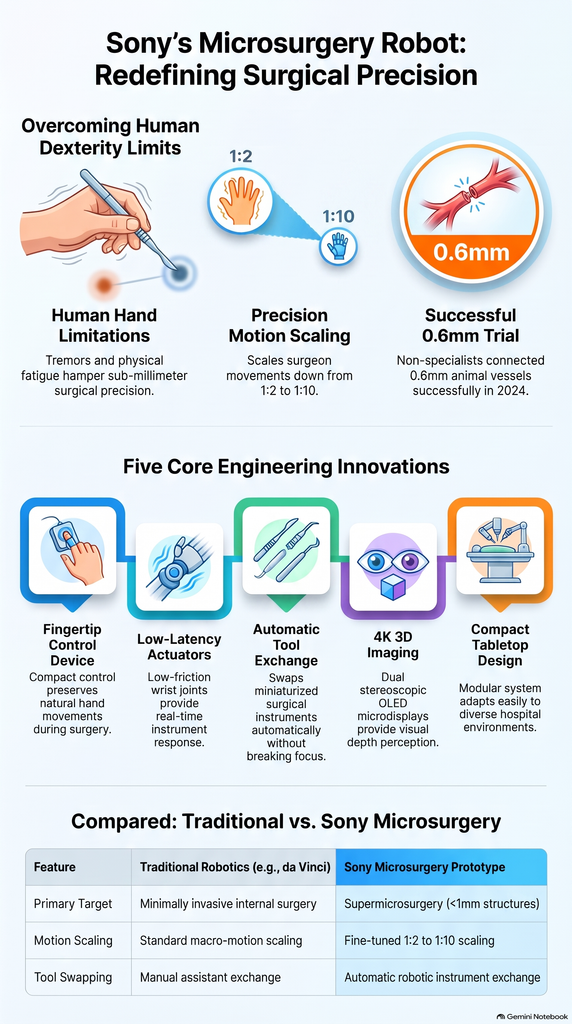
Depending on the configuration, the robot reproduces the surgeon’s movements at approximately half to one-tenth of their original size (a 1:2 to 1:10 ratio).
For example, if a surgeon moves their hand by one centimetre, the instrument tip could move just one millimetre when a 1:10 scaling ratio is used.
Think of it as a digital zoom, but applied to physical movement rather than an image.
The surgeon still decides what to do. The robot simply translates those decisions into movements that would be extremely difficult to reproduce manually.
This distinction is important: Sony is not developing an autonomous surgeon. It is developing a technological extension of the surgeon’s own hands.
3. Five technologies behind Sony’s microsurgery robot
The prototype combines several engineering innovations. Each addresses a different challenge associated with operating on extremely small anatomical structures.
3.1 Motion control designed around human fingertips
Microsurgery does not involve movements of the same size throughout an operation.
A surgeon might need to make an almost imperceptible movement to insert a needle into a blood vessel, followed by a much larger movement to pull a surgical thread.
Excessive motion scaling could make these larger movements unnecessarily slow or uncomfortable.
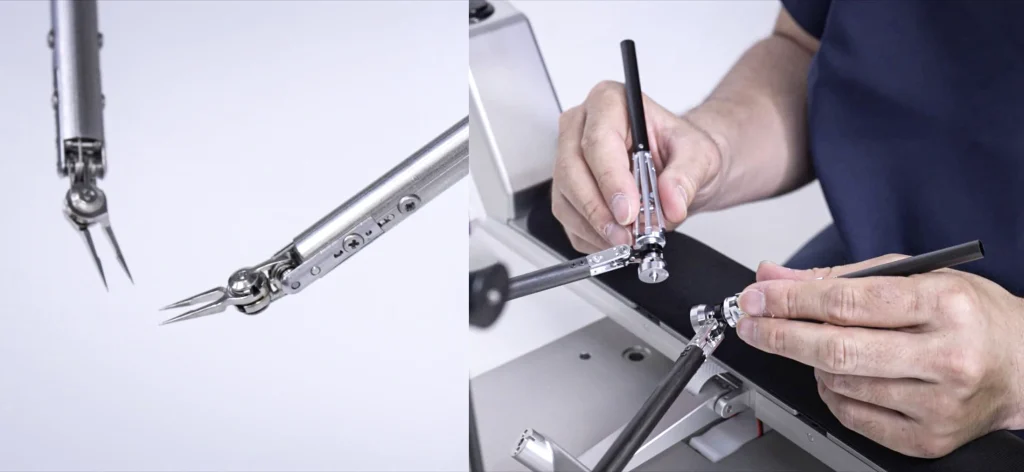
Sony addresses this challenge through a compact, lightweight control device designed to be operated with the fingertips.
The surgeon can rest their hand on a support while using delicate finger movements to control the robotic instruments.
The objective is to preserve the natural dexterity of the human hand while benefiting from robotic precision.
3.2 Smooth robotic movements with minimal delay
Imagine steering a car whose wheels respond half a second after you turn the steering wheel.
Even if the steering system were extremely precise, the delay would make driving uncomfortable and potentially dangerous.
A similar problem can occur in robotic surgery.
When a surgeon moves their hand, the instrument must respond immediately and predictably. Delays or jerky movements can interfere with the surgeon’s perception of control.
Sony has therefore designed its robotic arms with low-friction joints, including very small wrist-like joints at the instrument tips.
Its electronic control system also focuses on reducing latency: the time between the surgeon’s movement and the robot’s response.
The goal is to make the robotic instruments feel like a natural extension of the surgeon’s hands rather than an additional layer between the doctor and the patient.
3.3 Automatic surgical instrument exchange
During an operation, surgeons frequently switch between instruments.
For example, forceps may be used to hold delicate tissue, while scissors are needed to cut a thread.
In conventional robotic systems, changing instruments can require manual intervention and temporarily interrupt the workflow.
Sony has developed an automatic instrument exchange mechanism.
The prototype stores multiple miniaturised instruments close to its robotic arms and can automatically replace one instrument with another.
This is particularly relevant in microsurgery, where even small interruptions can disrupt the surgeon’s concentration and working rhythm.
The idea is simple: let the robot take care of the instrument exchange so the surgeon can remain focused on the procedure.
3.4 4K 3D imaging: Seeing the surgical world in greater detail
Precision is not just about moving accurately. It is also about seeing clearly.
When working on structures smaller than one millimetre, visual information becomes critical.
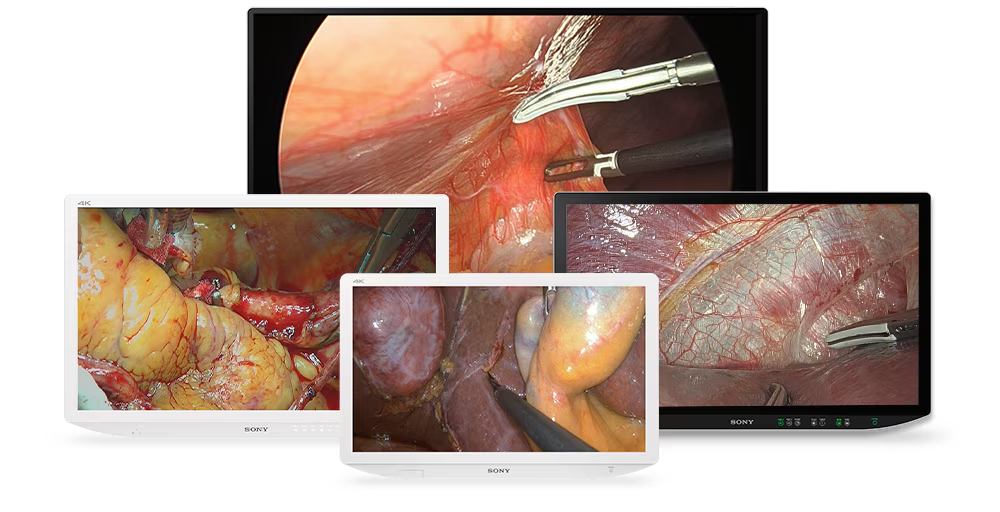
Sony’s prototype incorporates a 4K 3D stereoscopic camera and a viewing system equipped with 4K OLED microdisplays.
The two displays provide separate images to the surgeon’s eyes, recreating a sense of depth.
This is important because operating on tiny structures requires more than magnification. Surgeons must understand the spatial relationship between tissues, instruments and surgical threads.
High-resolution imaging, combined with stereoscopic vision, aims to provide a more detailed representation of the surgical field.
It is an interesting example of how Sony’s expertise in imaging and display technologies can contribute to a completely different industry: healthcare.
3.5 Compact design for different surgical environments
Finally, Sony has designed the system around a relatively compact tabletop console and robotic unit.
The objective is to make the technology adaptable to different facilities and surgical scenarios, rather than relying exclusively on large, complex installations.
If this approach proves clinically effective, compactness could become an important factor in making advanced robotic assistance available to more hospitals.
4. The experiment that demonstrated its potential
A promising technology needs more than impressive engineering specifications. It needs to demonstrate that it can solve a real medical problem.
Sony reached an important milestone in February 2024.
At Aichi Medical University in Japan, physicians and medical staff without specialist microsurgical training used the prototype to perform anastomosis on animal blood vessels measuring approximately 0.6 millimetres in diameter.
Anastomosis is the surgical connection of two tubular structures, such as blood vessels.
To appreciate the difficulty, imagine joining two extremely thin drinking straws without allowing their walls to collapse or obstruct the passage of liquid.
In real surgery, the challenge is considerably greater: the surgeon must align the vessel walls, place microscopic stitches and preserve the blood flow.
According to Sony, the experiment successfully demonstrated supermicrosurgical blood vessel anastomosis by professionals who were not specialised in this discipline.
The company described it as the world’s first successful supermicrosurgical blood vessel anastomosis using a surgical assistance robot with automatic instrument exchange, as of May 2024.
One particularly interesting observation came from a thoracic surgeon who had never previously performed microvascular anastomosis.
After using the system, he reported that he could connect tiny blood vessels with a sensation similar to manually connecting larger ones.
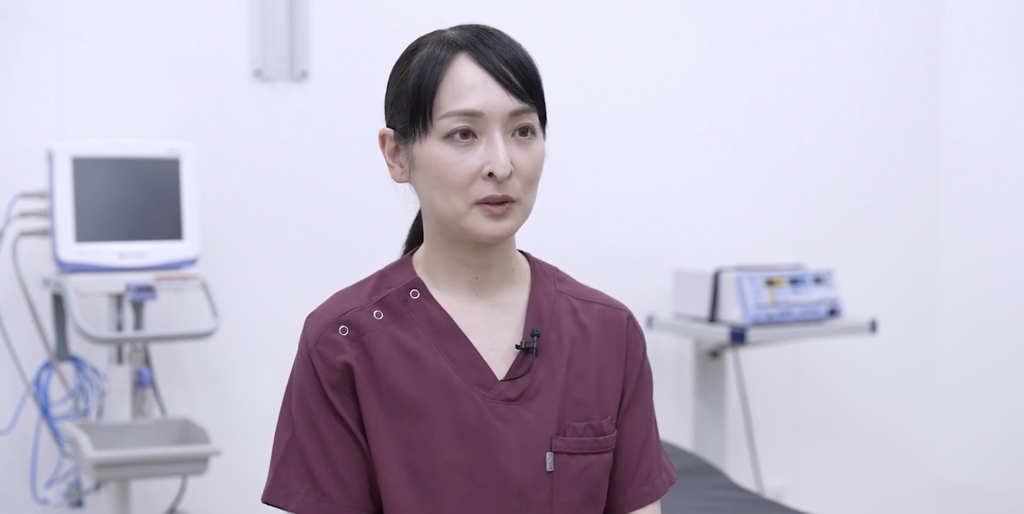
This is an important observation because it points towards something bigger than mechanical precision: the possibility of making highly specialised surgical skills easier to acquire and apply.
However, it is essential to understand what this experiment demonstrated. It was a proof of concept involving animal vessels, not a clinical trial proving that the system can safely perform operations on human patients.
5. From laboratory experiments to real medical applications
Why does all this matter?
Because microsurgery is not simply about operating on smaller structures. It can make treatments possible that would otherwise be difficult or even impossible.
One particularly interesting application is the treatment of lymphedema.
Lymphedema is a condition in which lymphatic fluid accumulates in body tissues, causing persistent swelling. It can occur following cancer treatments, particularly when lymph nodes have been removed or damaged.
In selected patients, surgeons can perform a procedure called lymphovenous anastomosis.
The idea is to connect a tiny lymphatic vessel directly to a nearby vein, creating an alternative route through which lymphatic fluid can drain into the bloodstream.
These connections are extremely delicate and often require supermicrosurgical techniques.
Robotic assistance could potentially help surgeons perform these procedures with greater precision and access particularly challenging anatomical locations.
Other possible applications include:
- Reconstructive surgery: reconnecting tiny blood vessels to restore blood supply to transplanted tissues.
- Peripheral nerve repair: connecting extremely small nerve structures following trauma or surgery.
- Lymphatic reconstruction: restoring or improving lymphatic drainage in patients affected by lymphedema.
- Complex vascular reconstruction: performing delicate connections between small blood vessels.
These applications are not all established uses of Sony’s prototype. They represent broader areas in which microsurgical robotic assistance could have a role.
6. Sony, da Vinci and the evolution of surgical robotics
When discussing robotic surgery, one name immediately comes to mind: the Da Vinci Surgical System, developed by Intuitive Surgical.
However, Sony’s project addresses a somewhat different technological challenge.
The da Vinci system was designed primarily to support minimally invasive surgery, allowing surgeons to operate through small incisions using specialised instruments and a three-dimensional visualisation system.
Its robotic arms reproduce the surgeon’s movements, while motion scaling and tremor reduction help improve control.
Sony’s prototype, by contrast, is being developed specifically around the needs of microsurgery, where the structures being manipulated can be less than one millimetre in diameter.
This distinction matters.
A robot designed to operate inside the human body through small incisions is not necessarily optimised for connecting extremely small blood vessels or manipulating delicate lymphatic structures.
Indeed, the development of dedicated microsurgical robotic platforms such as MUSA and Symani illustrates how this field is evolving towards increasingly specialised tools.
The future of surgical robotics may therefore not depend on a single universal platform, but on different robotic systems designed for different surgical challenges.
7. The challenges: What still needs to be proven?
Despite its potential, Sony’s project remains a research and development initiative.
There are several questions that need to be answered before this technology could become part of routine clinical practice.
Clinical validation
Successful experiments involving animal vessels are encouraging, but the system must demonstrate safety, reliability and effectiveness in appropriate human clinical studies.
Training and the learning curve
Robotic assistance may reduce some technical barriers, but it does not eliminate the need for anatomical knowledge, surgical judgement and experience.
Cost and accessibility
Advanced robotic systems require investment, maintenance, training and specialised infrastructure. Making the technology affordable will be essential if its benefits are to reach a wider range of hospitals.
Sensory feedback
Surgeons normally rely on touch to understand how tissues respond to instruments. Robotic systems can reduce or alter this tactile information, making visual feedback and instrument control particularly important.
Regulatory approval
Sony’s announcement in May 2024 explicitly stated that the prototype had not received regulatory approval in Japan and could not be sold or offered as a medical device at that time.
These are not reasons to dismiss the technology. They are the necessary steps between an exciting engineering demonstration and a reliable medical solution.
8. The bigger picture: Technology that expands human capabilities
There is an interesting idea behind Sony’s microsurgery robot.
For centuries, medicine has advanced by developing tools that extend what human beings can do.
The microscope allowed doctors to see structures that were previously invisible. Imaging technologies made it possible to explore the human body without opening it. Robotic surgery introduced new ways of controlling instruments with extraordinary precision.
Sony’s project takes this evolution one step further.
Instead of simply giving surgeons better instruments, it explores how technology can translate their natural movements into actions that exceed the physical limits of the human hand.
And perhaps its most important contribution could be something beyond precision itself.
If robotic assistance can make complex procedures easier to learn and perform, it may eventually help reduce the gap between hospitals with access to highly specialised expertise and those without it.
That future is not guaranteed. It will depend on clinical evidence, practical implementation and the ability to make these systems accessible.
But the underlying idea is worth remembering:
The most exciting future of surgical robotics may not be about replacing human hands with machines. It may be about giving human hands capabilities they never had before.
Musumeci Online – The Newsletter. Enjoyed this article? Subscribe to our monthly newsletter [here] to stay up to date with our latest content.
Leave a Reply