
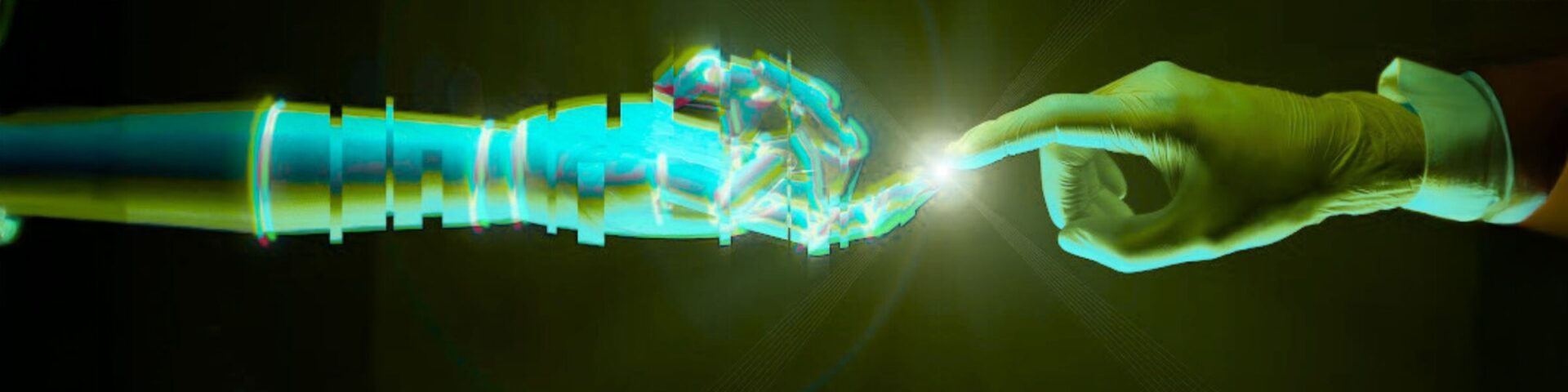
For decades, robotic surgery has been built on a paradox.
On one hand, it offers superhuman precision—steady movements, microscopic accuracy, and the ability to operate through tiny incisions. On the other, it removes something deeply human from the surgical experience: the sense of touch.
Now, that missing sense is coming back.
A new generation of robotic systems is being developed with sensorized fingertips and haptic feedback technologies, allowing surgeons not only to see what they are doing—but to feel it again, even from a distance.
It is a shift that may sound subtle, but in surgery, touch is everything.
Musumeci Online – The Podcast. It is perfect for driving, commuting, or waiting in line!
When vision is not enough
Traditional robotic systems in surgery rely heavily on high-definition imaging. Surgeons operate by watching a screen, interpreting depth, texture, and resistance visually.
But the human body is not just something to be seen—it is something to be felt.
A blood vessel does not only appear as a structure; it has tension. A tumor is not only a shape; it has stiffness. Healthy tissue “gives” differently than damaged tissue.
In open surgery, this feedback flows naturally through the surgeon’s hands. It is similar to how a pianist feels the resistance of keys or a sculptor senses the density of clay.
In robotic surgery, that feedback is often lost.
And that loss matters.
Without tactile feedback, surgeons must rely more heavily on visual cues, which increases cognitive load and can reduce precision in delicate procedures.
Robotic fingertips that “listen” to tissue
The new wave of innovation aims to solve this gap using haptic sensors embedded in robotic instruments.
These sensors measure forces such as:
- Pressure
- Resistance
- Vibration
- Micro-deformations of tissue
This data is then translated into signals that are sent back to the surgeon through force feedback systems—often through the control interface or even wearable devices.

A useful metaphor is to imagine driving a car on a perfectly smooth road… but with the steering wheel disconnected from the wheels. You can see where you are going, but you cannot feel the road.
Haptic technology reconnects that missing link.
Now, when the robotic instrument touches tissue, the surgeon can feel:
- When they are pressing too hard
- When tissue is fragile
- When resistance increases unexpectedly
In essence, the robot becomes a translator between the human hand and the biological world.
Why touch changes surgical performance
The reintroduction of tactile feedback is not just a comfort feature—it directly impacts performance and safety.
1. Reduced risk of tissue damage
Without touch, it is easier to apply excessive force unknowingly. With haptics, surgeons receive immediate feedback when pressure thresholds are exceeded.
2. Improved precision in complex environments
In areas like neurosurgery or cardiovascular procedures, millimeters matter. Feeling tissue stiffness helps distinguish structures that may look identical on a screen.
3. Lower cognitive load
Instead of constantly “translating” visual information into physical intuition, the surgeon regains a more natural interaction with the body—similar to traditional surgery, but enhanced.
It is comparable to learning to write without feeling the pen on paper. You can still write, but something intuitive is missing. Haptics restores that missing layer.

From remote manipulation to embodied interaction
Robotic surgery is often described as “teleoperation”—a human controlling a machine at a distance.
But with haptic feedback, something important changes: the robot starts to feel less like a tool and more like an extension of the surgeon’s body.
This concept is known in neuroscience as embodiment—when a tool becomes integrated into our sensory system.
A simple example is how people can adapt to using a pen, a tennis racket, or even a prosthetic limb until it feels “natural.”
In this case, the stakes are much higher: the “tool” is a surgical robot operating inside a human body.
The safety layer we did not know we were missing
One of the most promising aspects of haptic robotic systems is their potential as a real-time safety layer.
Think of it as an invisible boundary system:
- Too much force → immediate resistance feedback
- Wrong tissue interaction → vibration alert
- Unexpected anatomical density → warning signal
This creates a dynamic safety net that does not rely only on visual interpretation.
In complex surgeries, where fatigue or stress can affect decision-making, this second sensory channel may act as a stabilizer—reducing variability in outcomes.
Challenges still ahead
Despite the promise, this technology is still evolving.
Some key challenges include:
- Latency: feedback must be instantaneous to feel natural
- Calibration: different tissues require different sensitivity ranges
- Standardization: systems must work consistently across procedures
- Learning curve: surgeons must adapt to a hybrid sensory system
In other words, the goal is not just to add touch—but to integrate it seamlessly into surgical intuition.

A quiet transformation in how we operate
What is emerging is not just a better robot.
It is a new model of surgery where human perception and machine precision merge.
If early robotic surgery was about removing the surgeon from the operating table, this new phase is about something very different:
bringing the body back into the loop—digitally extended, but still deeply human.
In the future operating room, surgeons may no longer say “I see the tumor.”
They may say something new:
“I can feel it!”
And that single shift may redefine what precision medicine truly means.
Leave a Reply