
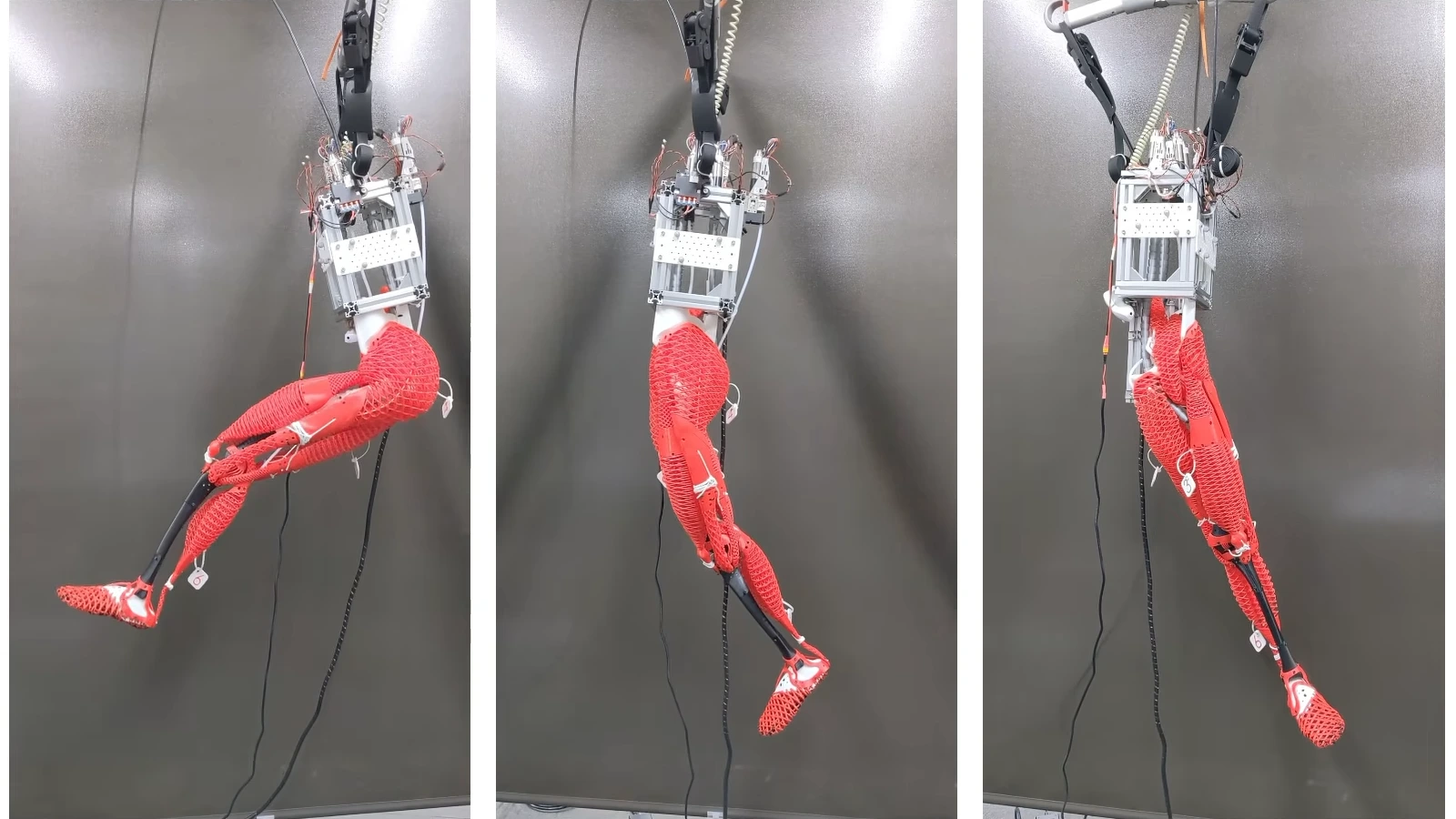
When we think about robots, we often picture machines made of metal, electric motors and rigid mechanical joints. They can be incredibly precise and powerful, but there is something they still struggle to reproduce: the natural flexibility of the human body.
Think about something as ordinary as walking down a staircase. Your muscles contract and relax, tendons transmit forces, ligaments stabilize your joints, and soft tissues absorb part of the impact. All these elements work together almost effortlessly, allowing you to adjust your movements continuously without even thinking about it.
Now imagine trying to recreate that system using conventional mechanical components.
It is not an easy engineering challenge.
Musumeci Online – The Podcast. It is perfect for driving, commuting, or waiting in line!
For decades, roboticists have explored ways to reproduce the human musculoskeletal system. But what if, instead of building increasingly sophisticated mechanical substitutes, we could manufacture structures that behave more like biological muscles, tendons and ligaments?
A research team from the University of Tokyo has taken an interesting step in this direction.
In a study published in Advanced Intelligent Systems in September 2026, researchers presented a new approach combining parametric design and flexible 3D printing to create artificial musculoskeletal structures using a single material.
Their work goes beyond producing individual artificial muscles. They integrated these components into a life-sized robotic leg, demonstrating how several muscle-inspired structures and flexible joints could work together.
And this opens an intriguing question: could the next generation of robots become more capable by learning not only how humans look, but also how our bodies are physically constructed?
1. Why reproducing the human body is such a difficult challenge
The human musculoskeletal system is an extraordinary example of biological engineering.
Our bones provide structural support, but movement depends on a much more complex network of interconnected elements.
Muscles generate forces through contraction. Tendons transmit those forces to bones. Ligaments stabilize joints and help prevent excessive or unwanted movements. Meanwhile, softer tissues cushion impacts and protect internal structures.
These components have different mechanical properties, even though they are made from biological materials that coexist within the same body.
Consider your knee.
It is not simply a hinge connecting two rigid pieces of bone. Its stability depends on several ligaments, including the anterior and posterior cruciate ligaments, while muscles and tendons contribute to controlling its movement.
Reproducing this arrangement in a robot requires much more than connecting two mechanical parts.
Traditional musculoskeletal robots have often used cables, wires and rigid mechanical joints to represent muscles and ligaments. These solutions work, but they simplify the biological structures they are trying to reproduce.
A cable can transmit tension, for example, but it does not have the volume, flexibility or cushioning properties of a real muscle.
Similarly, a conventional mechanical joint can control rotation, but it does not necessarily reproduce the way biological ligaments passively constrain and stabilize movement.
The challenge, therefore, is not simply to make a robot move. It is to reproduce some of the physical principles that make human movement smooth, adaptable and coordinated.
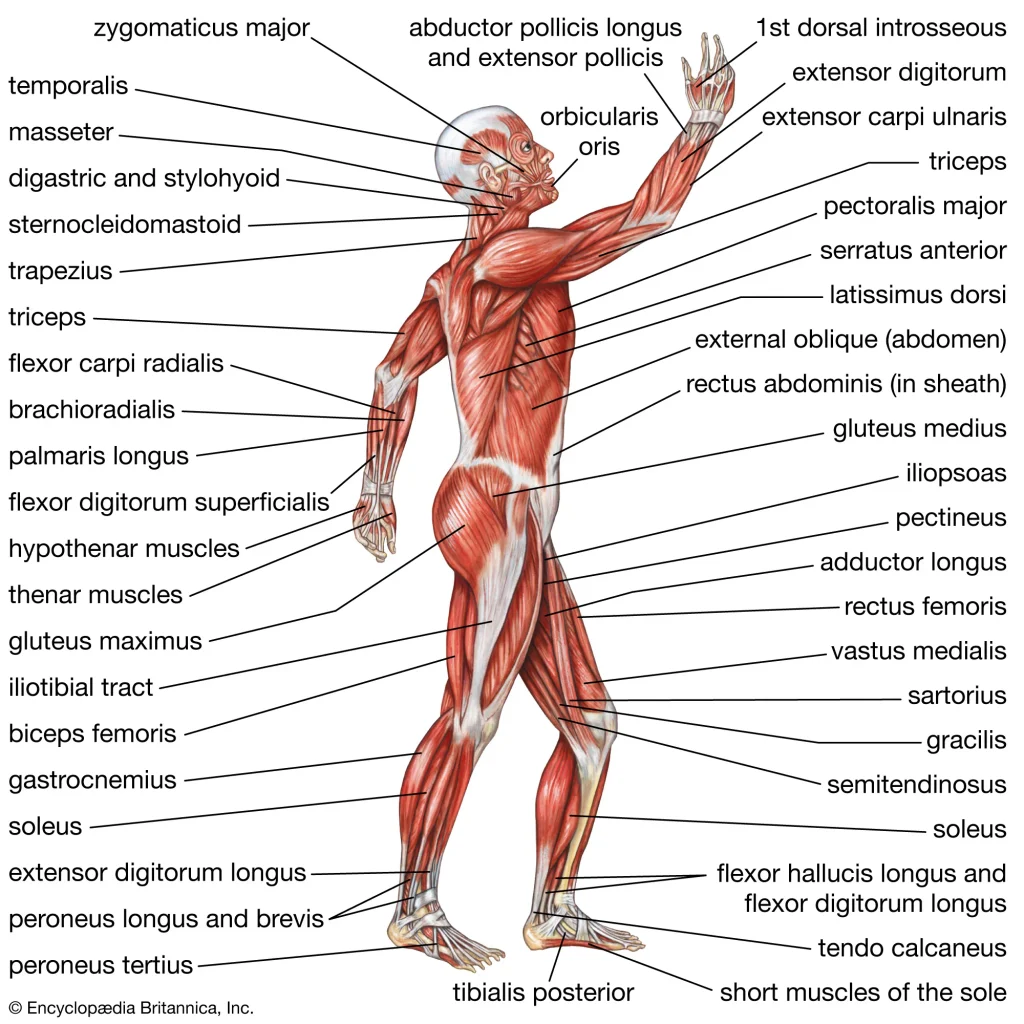
2. A new approach: artificial muscles, tendons and ligaments from one material
The University of Tokyo researchers proposed a manufacturing framework called Flexible Pattern Structure.
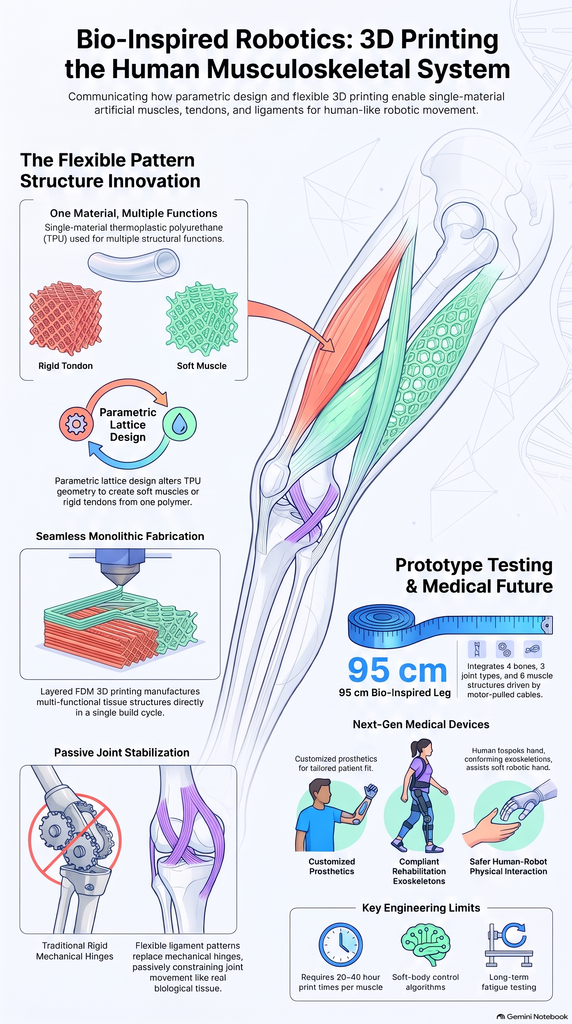
The central idea is surprisingly simple: instead of using different materials to reproduce different biological tissues, why not use the same flexible material and change its internal geometry?
The material selected was TPU, or thermoplastic polyurethane.
TPU is a flexible polymer widely used in applications requiring elasticity, abrasion resistance and mechanical durability. Depending on its formulation and structure, it can behave more like a soft rubber or a relatively firm flexible plastic.
But the really interesting part is not the material itself. It is how the researchers designed it.
Using 3D printing, they created intricate internal patterns made of interconnected branches and lattice-like structures. By changing the thickness, spacing, orientation and density of these patterns, they could modify how each printed component behaved when compressed, stretched or bent.
In other words, the same material could be engineered to perform different mechanical functions.
A structure with relatively sparse patterns could deform easily, making it suitable for a muscle-inspired component.
A denser structure could resist stretching more effectively, behaving like a tendon.
Other configurations could provide the flexibility and resistance required to reproduce ligament-inspired joint constraints or cushioning elements.
This is a fascinating engineering principle: sometimes, the architecture of a material can be just as important as the material itself.
3. The secret behind the technology: parametric design and 3D printing
To understand why this approach is interesting, we need to explore two technologies working together.
Parametric design: changing the behaviour without changing the material
Imagine building a mattress.
If you want it to feel softer, you could change the material. But you could also modify the arrangement, thickness and density of its internal springs.
The result would be a different mechanical response, even if the basic material remained the same.
This is broadly the principle behind parametric design.
Instead of manually designing every component from scratch, engineers define a series of parameters that control its geometry.
In the Tokyo research, these parameters included:
- The distance between structural branches.
- The thickness of each branch.
- The dimensions of the repeating lattice cells.
- The orientation and density of the internal patterns.
By adjusting these variables, researchers could generate structures with different mechanical characteristics.
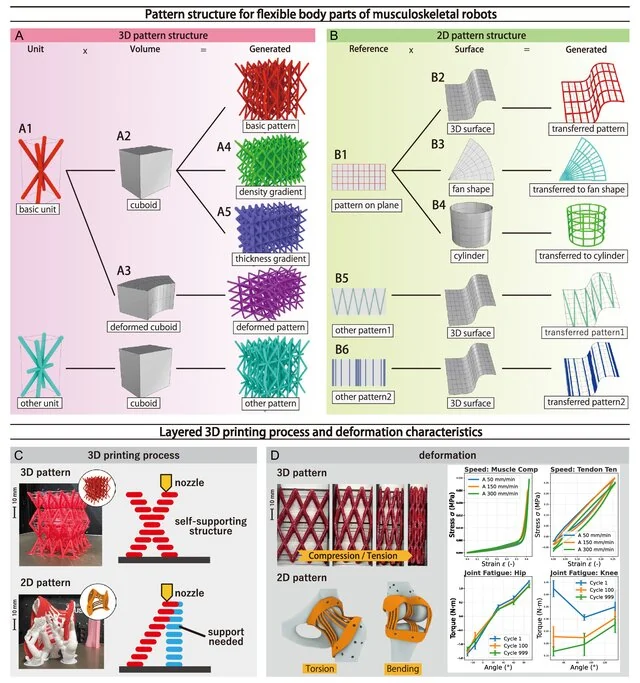
For example, a more open lattice allows greater deformation, while a denser configuration increases stiffness.
The advantage is that the design process becomes much more adaptable. Engineers can start from the shape of a particular anatomical region and automatically generate a structure with mechanical properties suited to its intended function.
3D printing: turning mathematical designs into physical structures
Once the geometry is defined, it can be manufactured using 3D printing.
The researchers used Fused Deposition Modeling (FDM), a process in which a printer deposits successive layers of melted thermoplastic material until the complete structure is formed.
Think of drawing a complex object using thousands of extremely thin layers, one on top of another.
Unlike conventional manufacturing, which often requires molds, several materials and substantial manual assembly, this method can produce intricate flexible structures directly from digital designs.
More importantly, the researchers could integrate different functional regions into a single printed component.
A muscle-inspired structure, for example, could gradually transition into a denser tendon-like region.
There is no need to manufacture two completely separate pieces and then connect them.
This approach could simplify the construction of increasingly complex robotic bodies.
4. From artificial muscles to robotic joints: recreating the biomechanics of a leg
The research becomes particularly interesting when we move from individual components to the complete robotic system.
The team designed structures inspired by four different biological functions:
Muscles: flexible structures that deform under external forces and provide the physical volume needed to reproduce muscle-like behaviour.
Tendons: stiffer elastic structures that transmit forces between the actuation system and the skeletal components.
Ligaments: patterned structures that constrain joint movements and help maintain the correct mechanical relationships between bones.
Cushioning tissues: flexible elements designed to absorb impacts and provide additional mechanical support.
One particularly interesting innovation concerns the joints.
Rather than relying exclusively on conventional mechanical bearings, the researchers designed ligament-inspired patterns around the joint surfaces.
By changing the orientation and density of these patterns, they could control the directions in which a joint could move.
This is important because biological joints are not simply mechanical hinges. Their movement is influenced by the combined action of bones, ligaments, muscles and surrounding tissues.
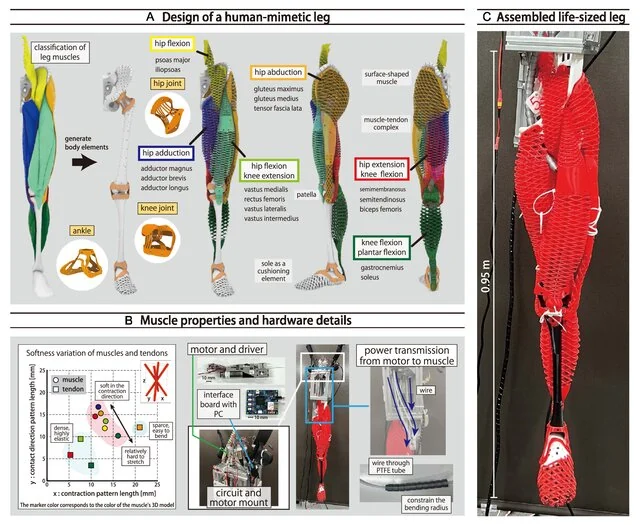
The researchers demonstrated this approach in three joints:
- Hip: a ball-and-socket configuration allowing several directions of movement.
- Knee: a joint designed primarily for flexion and extension.
- Ankle: a joint reproducing the main movements involved in raising and lowering the foot.
The resulting structures achieved ranges of motion broadly comparable to representative human joint movements, although they were not exact anatomical reproductions.
The team was therefore able to reproduce several important biomechanical principles without relying on conventional rigid joint mechanisms for the ligament-based constraints.
5. A life-sized robotic leg: putting the concept to the test
Designing a flexible artificial muscle is one thing. Making several of them work together is a much bigger challenge.
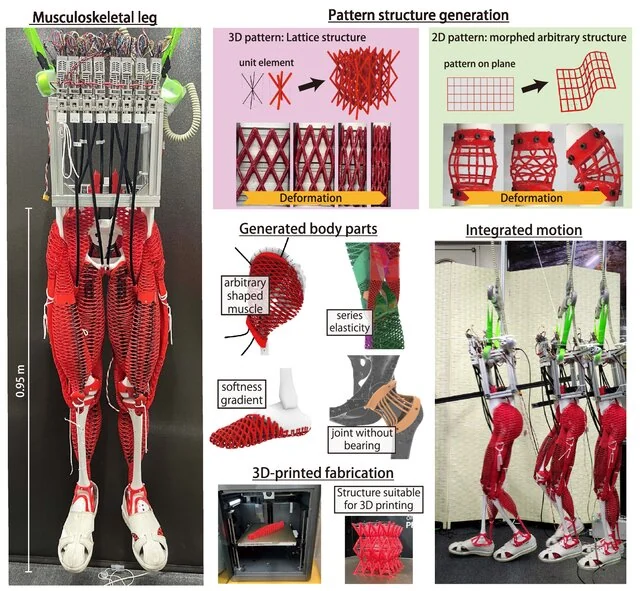
To test their approach, the researchers built a life-sized lower-limb robotic system measuring approximately 95 centimetres.
The prototype incorporated:
- Four main skeletal components: pelvis, femur, tibia and foot.
- Three joints: hip, knee and ankle.
- Six major muscle-inspired structures.
- Tendon-like elastic elements.
- A cushioning structure beneath the foot.
An important detail is that the system did not use artificial muscles that generated their own contraction.
Instead, electric motors pulled wires connected to the muscle-inspired structures. The flexible TPU components provided the volume, elasticity and mechanical interaction needed to reproduce aspects of biological muscle behaviour.
This distinction matters: the innovation is primarily in the design of the flexible musculoskeletal architecture, not in discovering a new electrically powered artificial muscle.
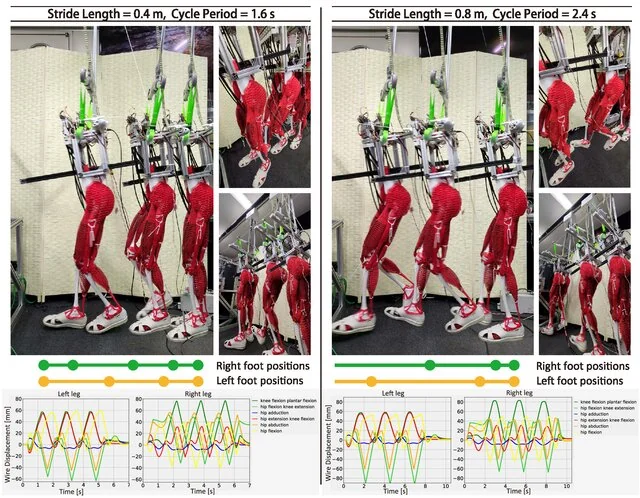
The researchers demonstrated several movements, including hip flexion, knee extension, hip abduction, knee flexion and ankle movement.
They also extended the system into a two-legged configuration.
The result was particularly interesting: the robotic legs could perform alternating stepping movements, coordinating multiple muscle-inspired structures and joints.
However, there is an important qualification.
The robot was suspended using external support. This helped carry part of its weight and restricted the movement of the torso to keep the system stable.
It therefore demonstrated coordinated stepping, but it did not achieve autonomous walking.
Nevertheless, the experiment showed that the proposed architecture could integrate multiple flexible components into a coordinated, life-sized robotic system.
And that is a meaningful step towards more sophisticated musculoskeletal robotics.
6. Why could this matter for medicine?
At first glance, a life-sized robotic leg might seem more relevant to humanoid robotics than to healthcare.
But the underlying engineering principles have interesting implications for medical technology.
The key is that medical devices increasingly need to interact physically with the human body.
And the more naturally a robotic structure can respond to movement, pressure and mechanical forces, the more interesting it becomes for applications involving human mobility.
Let’s explore three possibilities.
Smarter prosthetics: restoring more natural movement
Modern prosthetic limbs have evolved enormously.
Some incorporate advanced sensors, electronic control systems and powered joints that help users perform increasingly complex movements.
However, reproducing the natural mechanical behaviour of muscles, tendons and soft tissues remains challenging.
A prosthesis does not simply need to move a joint. It must interact with the user’s body, distribute forces and respond to changing mechanical conditions.
Flexible 3D-printed structures could eventually help engineers develop prosthetic components that are lighter, more adaptable and better suited to the mechanical characteristics of individual users.
Parametric design could also make customization easier.
For example, the geometry of a prosthetic component could be adjusted to accommodate different body dimensions, functional requirements or levels of mechanical resistance.
This does not mean the technology is already ready for clinical prosthetics. Rather, it offers a potential manufacturing approach that could contribute to future developments.
Rehabilitation and exoskeletons: working with the body, not against it
Exoskeletons are wearable robotic devices designed to support or enhance human movement.
They are being investigated and used in different contexts, including rehabilitation after neurological injuries and assistance for people with mobility limitations.
One of their main engineering challenges is ensuring that the device moves in harmony with the person wearing it.
Human joints are not perfectly rigid mechanical pivots. Their movement involves small variations, soft-tissue deformation and continuous adjustments.
A rigid exoskeleton can therefore create alignment and interaction challenges if its mechanical structure does not properly accommodate the user’s anatomy.
Flexible, biomimetic structures could offer another way to approach this problem.
By incorporating elements that deform and distribute forces, future exoskeletons might achieve more comfortable and adaptable physical interaction.
This could be particularly interesting in rehabilitation, where the relationship between the patient’s movement and the assistance provided by the device is essential.
Assistive robotics: machines designed to interact more safely with people
Robots are increasingly being considered for applications in healthcare environments, from assisting with physical tasks to supporting people with reduced mobility.
But working alongside humans requires more than precision.
A robot must also be able to interact with objects and people without applying unnecessary force or causing harmful impacts.
Soft and compliant structures could help address this challenge.
For example, a robotic assistant with flexible components might be better equipped to adapt when handling an object with an irregular shape or making physical contact with a person.
The research does not demonstrate a medical assistant robot, but it contributes to the broader engineering foundations that could eventually support such systems.
7. What are the limitations? From laboratory demonstrations to real-world applications
As promising as this research is, there are still several challenges to overcome.
The first concerns durability.
TPU structures can deform repeatedly, but they also exhibit viscoelastic behaviour. This means their mechanical response can change depending on how long a force is applied and how many times they have been loaded.
The researchers tested their structures over 999 loading cycles. Although no rupture occurred in those tests, some mechanical properties changed, particularly during the initial cycles.
Longer-term testing will be necessary to establish how these structures behave under the repeated stresses associated with real-world robotic operation.
The second challenge is manufacturing time.
Although 3D printing simplifies fabrication and reduces the need for molds and manual assembly, producing large flexible components is not necessarily fast.
The researchers reported printing times of approximately 20–40 hours for individual muscle components.
The third challenge is control.
Flexible structures behave differently from rigid mechanical components. Their shape can change under load, their internal forces are harder to predict, and the relationship between motor movement and joint movement can vary.
Future systems will therefore require more sophisticated control strategies, potentially incorporating sensors and machine-learning techniques to understand and compensate for these variations.
Finally, there is the challenge of autonomous movement.
The researchers demonstrated coordinated stepping under external suspension, but independent balance and walking remain unsolved objectives for this prototype.
These limitations are not unusual for early-stage robotics research. They simply illustrate how much work remains between an interesting laboratory demonstration and a technology ready for everyday use.
Conclusion: The future of robotics may be softer than we think
For a long time, progress in robotics has been closely associated with stronger motors, more precise mechanical components and increasingly sophisticated control systems.
But the human body suggests another direction.
Our ability to move naturally does not depend on rigid structures alone. It emerges from the interaction of bones, muscles, tendons, ligaments and soft tissues, each contributing different mechanical properties.
The University of Tokyo research offers an interesting way to reproduce some of these principles using parametric design and flexible 3D printing.
By changing the internal geometry of a single material, researchers can create structures that behave differently depending on their intended function. And by integrating these structures, they have demonstrated a life-sized robotic leg capable of coordinated movements.
We should not mistake this prototype for a walking humanoid or a medical device ready for clinical use. Its significance lies somewhere else: it provides a common engineering framework for building more biologically inspired robotic bodies.
And this could eventually matter far beyond humanoid robots.
From more adaptable prosthetics to wearable rehabilitation systems and assistive technologies, the ability to engineer structures that interact more naturally with the human body could become an important part of future medical innovation.
Perhaps the next major step in robotics will not simply be about making machines stronger, faster or smarter.
It will also be about making them more like us — not in appearance, but in the way they move, adapt and interact with the world.
Research reference
Yoshimura, S., Kawaharazuka, K., & Okada, K. (2026). Accelerating Musculoskeletal Robotics Through Parametric Design and 3D-Printed Flexible Structures. Advanced Intelligent Systems.
Musumeci Online – The Newsletter. Enjoyed this article? Subscribe to our monthly newsletter [here] to stay up to date with our latest content.
Leave a Reply