Not long ago, medicine advanced mainly through new drugs, better hospitals, and more specialized doctors. Today, something different is happening. Technology is no longer just supporting healthcare from the outside — it is becoming part of how health itself is understood, delivered, and improved.
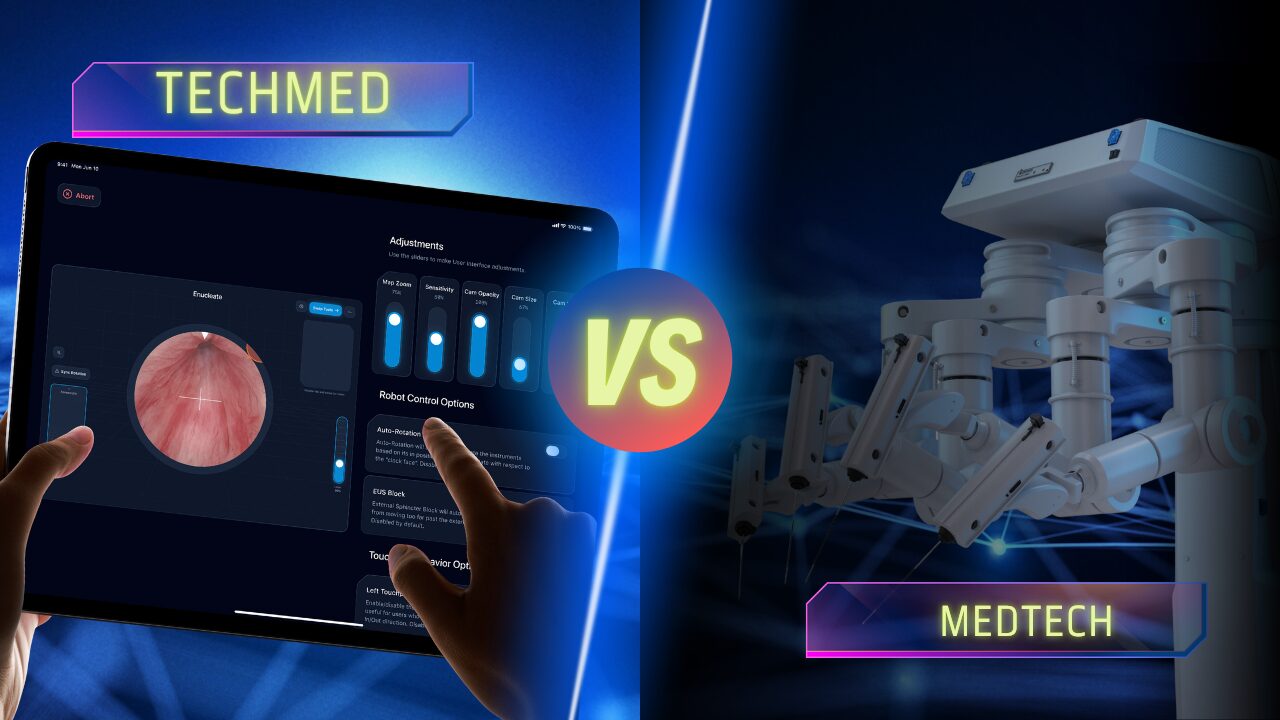
This new frontier is often described using two terms that sound similar but mean different things: MedTech and TechMed. Understanding the difference between them helps explain how technology and medicine are merging — and why this matters for all of us.
You don’t need a technical background to follow this journey. Think of it as a conversation about how smartphones, data, machines, and intelligent systems are quietly reshaping how we stay healthy, heal, and live longer.
Musumeci Online – The Podcast. It is perfect for driving, commuting, or waiting in line!
What Is MedTech? Technology Serving Medicine
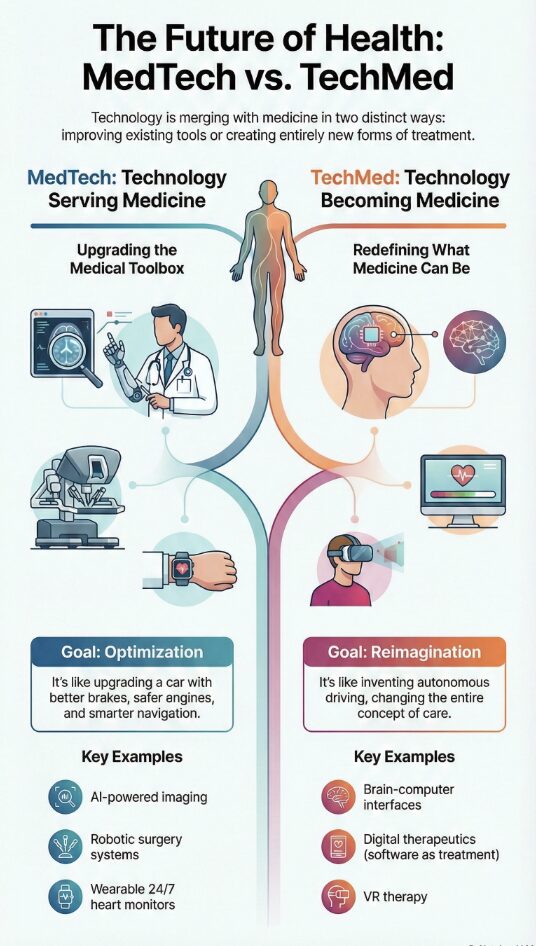
MedTech, short for Medical Technology, refers to technologies created specifically to support doctors, hospitals, and patients. In simple terms, MedTech is about building better tools for medicine.
Imagine upgrading from a paper map to GPS. The destination stays the same, but the journey becomes safer, faster, and more precise. That’s MedTech.
Examples include:
- Robotic surgery systems that allow surgeons to operate with millimeter precision
- AI-powered imaging tools that help detect tumors earlier in X-rays or MRIs
- Wearable medical devices, like heart monitors that track patients 24/7
- Smart implants that adjust treatments inside the body, such as insulin delivery systems
To put scale into perspective: if a traditional doctor could analyze 10 medical images per hour, an AI-assisted system can review thousands in the same time — like switching from reading one page at a time to scanning an entire library in minutes.
MedTech improves how medicine is practiced, making healthcare more accurate, efficient, and accessible, while doctors remain at the center of decisions.
What Is TechMed? When Technology Becomes Medicine
TechMed flips the perspective.
Instead of asking, “How can technology help doctors?”, TechMed asks, “What if technology itself becomes part of the medical solution?”
Here, technology doesn’t just assist medicine — it reshapes it.
Think of how streaming changed music. We didn’t just get better CDs; we got a new way of listening, discovering, and sharing songs. TechMed is doing something similar to healthcare.
Examples include:
- Brain-computer interfaces that allow paralyzed patients to move robotic limbs using thought
- Neurotechnologies that stimulate specific brain areas to treat depression or Parkinson’s disease
- Digital therapeutics, where software itself acts as a prescribed treatment
- Virtual reality therapies used to reduce chronic pain or treat phobias
In these cases, technology is not a tool around medicine — it is embedded within the therapy itself.
If MedTech upgrades the medical toolbox, TechMed redefines what medicine can be.
MedTech vs TechMed: A Simple Way to See the Difference
A useful analogy is transportation.
- MedTech is like improving cars: safer brakes, better navigation, smarter engines.
- TechMed is like inventing autonomous driving: the entire concept of mobility changes.
Both matter. Both coexist. But they operate at different levels of transformation.
MedTech focuses on optimization.
TechMed focuses on reimagination.
How AI Is Changing Diagnosis and Decision-Making
Artificial Intelligence sits at the intersection of MedTech and TechMed.
On one side, AI helps doctors detect diseases earlier. For example, AI systems can spot patterns in medical images that the human eye might miss — similar to how streaming platforms recommend movies by recognizing viewing habits you don’t consciously notice.
On the other side, AI-driven systems are starting to predict health risks before symptoms appear, using data from wearables, genetics, and lifestyle patterns. This shifts healthcare from “treating illness” to “preventing it.”
Instead of waiting for the engine to fail, healthcare becomes more like predictive car maintenance.
From Smart Implants to Digital Bodies
One of the most fascinating shifts is happening inside the human body itself.
- Smart implants can monitor healing after surgery
- Connected pacemakers can alert doctors before problems arise
- Neural implants can restore communication between brain and body
These technologies blur the line between biology and engineering. The body becomes partially digital — not in a science-fiction way, but in a practical, life-improving one.
It’s similar to how smartphones extended our memory, navigation, and communication. Medical technologies are now extending physical and cognitive health.
Why This Matters for Everyone, Not Just Experts
You don’t need to be a doctor or engineer to be affected by MedTech and TechMed.
These innovations influence:
- How early diseases are detected
- How personalized treatments become
- How healthcare costs evolve
- How long and how well people live
As technology continues to merge with medicine, conversations about health are becoming conversations about data, ethics, access, and human experience.
Health is no longer confined to hospitals. It lives in apps, devices, algorithms, and increasingly, within us.
A New Frontier Worth Talking About
MedTech and TechMed are not competing ideas. They are two complementary paths shaping the same future — one where medicine becomes more precise, more human-centered, and more proactive.
This is why technology and healthcare have become one of the most exciting frontiers of our time. Not because machines replace doctors, but because they help medicine move closer to what it has always aimed to be: better care for every individual.
And perhaps the most important shift of all is this: health is no longer just something we fix when it breaks — it’s something we continuously design.
Leave a Reply