A noisy restaurant can reveal something remarkable about the human brain.
Imagine sitting at a table with several conversations happening around you. Glasses are clinking, music is playing, people are talking, and yet you can usually focus on the person sitting opposite you. Your brain somehow decides which voice matters and which sounds can be ignored.
For someone with hearing loss, however, this seemingly simple task can become extremely difficult.
Traditional hearing aids can make sounds louder and reduce some background noise, but they generally do not know which conversation you actually want to hear.
Now researchers are beginning to explore a very different approach: what if a hearing device could ask the brain?
A recent study published in Nature Neuroscience provides an important step in that direction. Researchers developed a brain-computer interface (BCI) capable of decoding which speaker a person was paying attention to and using that information to selectively enhance the corresponding voice.
It is a fascinating example of a much bigger transformation taking place in medicine.
BCIs are evolving from experimental systems that simply read brain signals into closed-loop medical technologies that can interpret those signals and respond in real time.
And that could change not only hearing, but also neurological rehabilitation, communication, movement and, eventually, the way doctors interact with the nervous system.
Musumeci Online – The Podcast. It is perfect for driving, commuting, or waiting in line!
What exactly is a brain-computer interface?
The concept sounds futuristic, but the basic principle is surprisingly simple.
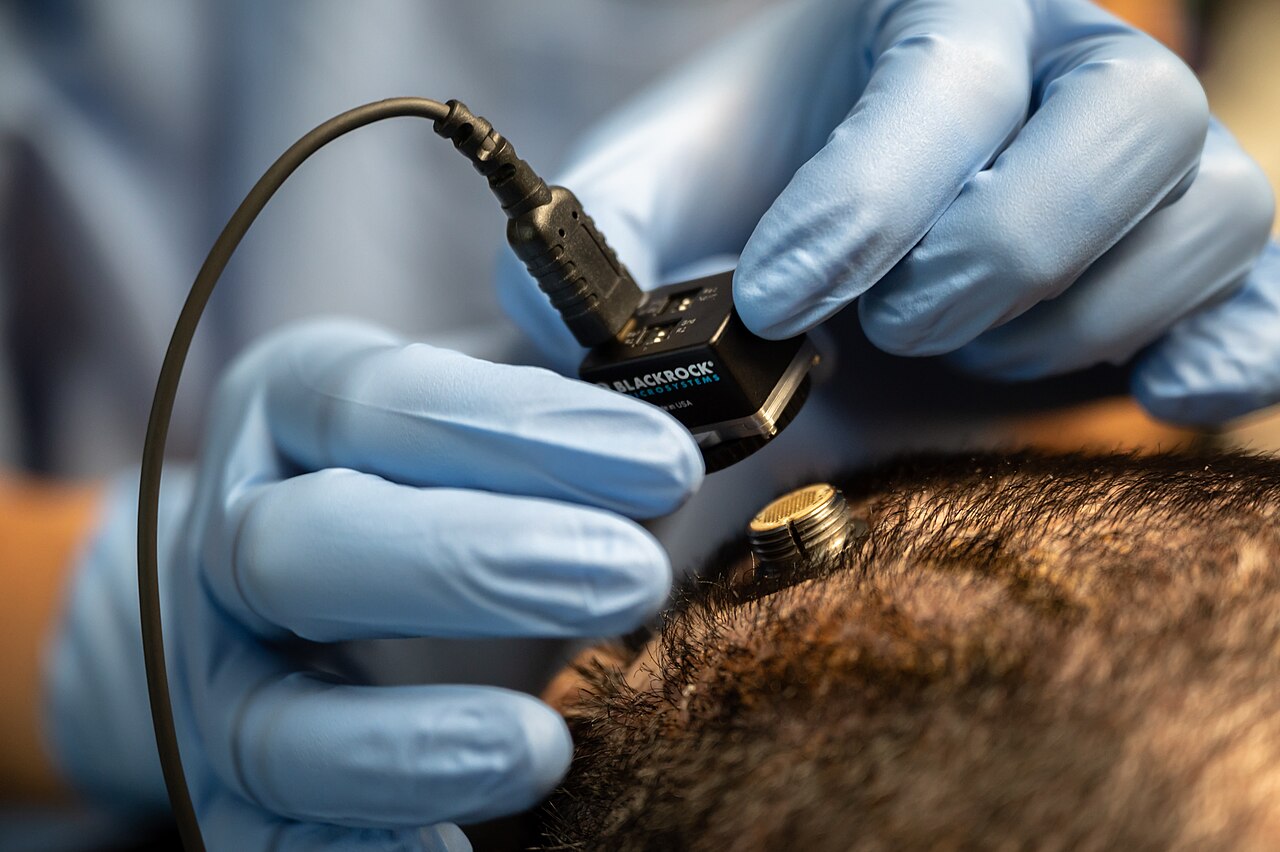
A Brain-Computer Interface creates a communication pathway between brain activity and an external device.
Normally, the brain communicates with the outside world through biological pathways. If you want to move your hand, for example, your brain sends electrical signals through the nervous system to your muscles.
A BCI attempts to intercept some of this information.
The system typically has three basic stages:
1. Capture the brain signal.
Sensors detect electrical or physiological activity generated by the brain.
2. Decode the signal.
Algorithms analyse the neural activity and try to determine what the person is doing, intending or paying attention to.
3. Produce an output.
The decoded information is translated into an action: moving a cursor, producing speech, controlling a robotic limb—or, in the new hearing research, modifying the sound reaching the listener.
This can be compared to a translator.
The brain is speaking in the language of electrical activity. The computer does not understand that language directly. The BCI acts as an interpreter between the two.
Modern systems increasingly add another step: feedback.
The device acts on the decoded information, the person receives the result, and the brain responds again.
This creates what researchers call a closed-loop system.
In other words, the technology does not simply read the brain.
It reads, responds and continuously adapts.
A 2026 review aimed specifically at clinicians highlights this evolution and describes BCI systems in terms of signal acquisition, processing, translation and feedback, while also pointing to their growing range of clinical applications.
The “cocktail party problem”
The recent hearing breakthrough is based on a problem neuroscientists have studied for decades: the so-called cocktail party problem.
Suppose two people are speaking at the same time.
Your ears receive both voices. But your brain does not treat them equally. It can selectively concentrate on one speaker while suppressing the other.
Researchers call this ability auditory attention.
The challenge is that a conventional hearing aid mostly operates from the information available in the environment. It can analyse the incoming sound, but it does not necessarily know what the listener’s brain has decided is important.
The BCI approach changes the equation.
Instead of asking only:
“What sounds are coming into the ear?”
the system asks:
“Which sound is the person’s brain trying to follow?”
That distinction is crucial.

From brain signals to selective hearing
The 2026 Nature Neuroscience study used a particularly sophisticated form of neural recording called intracranial electroencephalography (iEEG).
Four people who were already undergoing clinical monitoring for epilepsy had electrodes implanted inside the skull as part of their medical care. The researchers were therefore able to access high-resolution recordings from areas involved in auditory processing.
The participants listened to two conversations simultaneously.
The BCI analysed their neural activity to determine which conversation they were attending to.
The system then dynamically modified the audio, increasing the relative prominence of the attended speaker.
This is important because the experiment was not simply asking whether a computer could guess what someone was listening to.
It tested whether that information could be used in real time to improve perception.
And the results were encouraging.
The participants showed improved speech intelligibility, reduced listening effort and a strong preference for the system when it was active. Individual participants preferred the brain-controlled system in approximately 75% to 95% of trials.
The researchers also tested the output with 40 people with hearing loss. The brain-controlled audio was preferred and produced improved speech intelligibility compared with the baseline condition.
This is a meaningful milestone.
The field is moving from:
“We can decode attention.”
to:
“We can decode attention and use it to change the patient’s experience.”
That is the essence of a closed-loop medical technology.
Why this is more than a better hearing aid
It might be tempting to see this as simply a sophisticated hearing aid.
But the underlying idea is much broader.
Traditional assistive technologies generally compensate for a lost function by modifying the environment.
BCIs can potentially do something different: they can adapt the technology according to information coming directly from the nervous system.
Consider the difference.
A conventional hearing aid might detect loud background noise and reduce it.
A brain-controlled hearing system could potentially determine that you are concentrating on the person sitting across the table and prioritise that person’s voice.
The technology is therefore becoming more personalised.
It is not just responding to the environment.
It is responding to the patient’s neurological state.
That same principle could have enormous implications beyond hearing.
BCIs are already moving into rehabilitation
Hearing is only one piece of the BCI story.
Researchers are investigating BCIs for people with stroke, spinal cord injury, amyotrophic lateral sclerosis (ALS), Parkinson’s disease and other neurological conditions.
One of the most promising applications is neurorehabilitation.
A conventional rehabilitation session might involve asking a patient to attempt a movement repeatedly.
A BCI can potentially detect the patient’s intention to move—even when the physical movement is weak or impossible—and use that signal to trigger an external device.
For example, imagine a stroke survivor trying to open their hand.
The movement may be too weak to produce a useful physical action.
But if the BCI can detect the patient’s intention to move, that signal could potentially activate functional electrical stimulation, a robotic device or another assistive system.
- The patient thinks about the movement.
- The technology detects the intention.
- The device assists the movement.
And repeated interaction may provide the nervous system with feedback that supports rehabilitation.
This is particularly interesting because BCIs are increasingly being studied as closed-loop systems, rather than simple control interfaces.

A 2026 systematic review of closed-loop BCIs for stroke rehabilitation identified 42 relevant original studies and reported potential benefits across motor and cognitive rehabilitation, while also highlighting the need for larger and more standardised clinical trials.
Another 2026 meta-analysis covering 12 randomised controlled trials found that BCI-based training was associated with improvements in global cognitive function, attention, executive function and activities of daily living in stroke survivors, although memory did not show a significant improvement.
The message is encouraging, but it is important not to confuse promising evidence with established routine treatment.
Most BCI applications are still somewhere between experimental research and early clinical translation.
The other revolution: communication
BCIs may also provide a communication channel for people who have lost the ability to speak or move.
This is particularly relevant for people with severe paralysis or locked-in syndrome.
The idea has existed for years. Earlier BCI systems could allow patients to select letters or control a computer using brain activity. The problem was speed, reliability and practicality.
But progress in neural decoding and artificial intelligence is changing the possibilities.
Instead of requiring a patient to select individual letters, future systems may decode richer patterns related to speech, language or intended communication.
This represents an important shift.
The objective is no longer simply to give a patient a way to control a computer.
It is to create a more natural communication pathway between intention and expression.
Clinical research is already exploring implanted BCIs for communication in people with severe motor impairment, including patients with ALS and brainstem stroke. For example, Johns Hopkins is currently conducting an early-feasibility study of an implanted BCI designed to support communication.
Why artificial intelligence matters
There is another technology quietly powering much of this progress: artificial intelligence.
Brain signals are complex.
They vary from person to person and even from one moment to another in the same person.
The neural pattern associated with an intended movement or a particular focus of attention is not a simple on/off switch.
Machine-learning algorithms can identify patterns in these signals that would be extremely difficult to detect manually.
This creates a powerful combination:
- Neuroscience provides the signal.
- Sensors capture it.
- AI interprets it.
- The medical device acts on it.

The better the algorithms become at interpreting neural activity, the more useful BCIs may become.
But there is an important limitation.
A BCI that works beautifully in a laboratory is not necessarily a medical device ready for everyday life.
From laboratory breakthrough to clinical reality
This may be the biggest challenge facing the BCI field.
The recent selective-hearing study used intracranial recordings because they provide exceptionally high-quality neural signals. But implanting electrodes into the brain is an invasive medical procedure.
That makes the technology powerful—but difficult to scale.
Researchers therefore have to solve several problems simultaneously:
- Can the system remain reliable for years?
- Can neural signals be decoded without frequent recalibration?
- Can the technology become smaller and more comfortable?
- Can useful signals be obtained non-invasively?
- What happens when the patient is tired, distracted or moving?
- How much training does the patient need?
- Can the system be made affordable?
- What clinical evidence is sufficient to demonstrate safety and effectiveness?
A 2026 review of clinical translation argues that the field is increasingly moving beyond a purely technical challenge. The question is no longer only whether researchers can make BCIs work, but whether they can make them safe, effective, affordable and sustainable in real healthcare environments.
That distinction matters enormously.
A technology can be technically impressive and still fail as a medical technology.
The next frontier: technology that understands intention
Perhaps the most exciting aspect of BCIs is that their future may not be limited to restoring lost functions.
They could also help medicine understand the brain in increasingly precise ways.
The recent hearing research provides a useful example.
The system does not simply measure whether a person is hearing something.
It attempts to determine what the person is paying attention to.
That takes us one step closer to a medical technology capable of interacting with intention rather than merely observing physiology.
And this idea is expanding.
Researchers are beginning to investigate cognitive BCIs that could potentially interact with functions such as attention and memory. A 2026 review in Trends in Cognitive Sciences describes cognitive BCIs as an emerging field, while stressing that decoding cognitive functions presents fundamentally different challenges from decoding movement or communication.
This is where the discussion becomes particularly interesting.
If technology can eventually decode increasingly sophisticated aspects of brain activity, where should medicine draw the line between restoration and augmentation?
A device designed to help a paralysed patient communicate is relatively easy to justify.
What about a device designed to enhance memory in someone who is healthy?
Or improve attention?
Or change how a person experiences sensory information?
These questions are already appearing in neuroethics and neurosurgery.
The medical future may be a conversation
The most interesting future for BCIs may therefore not be about replacing the doctor—or even replacing the patient’s lost biological function.
It may be about creating a new communication channel between patient, brain and technology.
A patient generates a neural signal.
The system interprets it.
The medical device responds.
The patient receives feedback.
And the cycle begins again.
This is fundamentally different from the traditional model of medicine, where clinicians observe symptoms, make decisions and deliver treatment.
BCIs introduce the possibility of a much more dynamic relationship.
The treatment itself can potentially respond to what is happening inside the patient’s nervous system.
That is why the brain-controlled hearing experiment matters beyond hearing.
It demonstrates a principle that could eventually influence many areas of medicine:
Technology does not always need to replace a biological function. Sometimes its greatest value may come from learning how that function works—and helping the body use it more effectively.
We are still far from a world in which everyone wears a brain-computer interface.
Most BCIs remain experimental, and significant scientific, clinical, regulatory, economic and ethical barriers remain.
But the direction of travel is becoming clearer.
The next generation of medical technology may not simply see, hear, move or communicate on behalf of the patient.
It may begin to understand what the patient’s brain is trying to do—and help make it possible.
And that could be one of the most important transitions in the evolution of digital medicine.
Sources and further reading
- Choudhari V. et al. Real-time brain-controlled selective hearing enhances speech perception in multi-talker environments. Nature Neuroscience, 2026.
- Jain A. et al. Brain-computer interface: an update for the clinicians. Frontiers in Human Neuroscience, 2026.
- Cheng Y. et al. Advancing stroke rehabilitation: the potential and challenges of closed-loop brain-computer interface technology. Frontiers in Neurology, 2026.
- Fan Y. et al. The effect of brain-computer interface training on cognitive function in stroke patients: a systematic review and meta-analysis. Journal of Neurology, 2026.
- Sun H. et al. Clinical translation and accessibility of brain-computer interfaces: From technology development to clinical application. Biomedical Science & Technology, 2026.

Leave a Reply