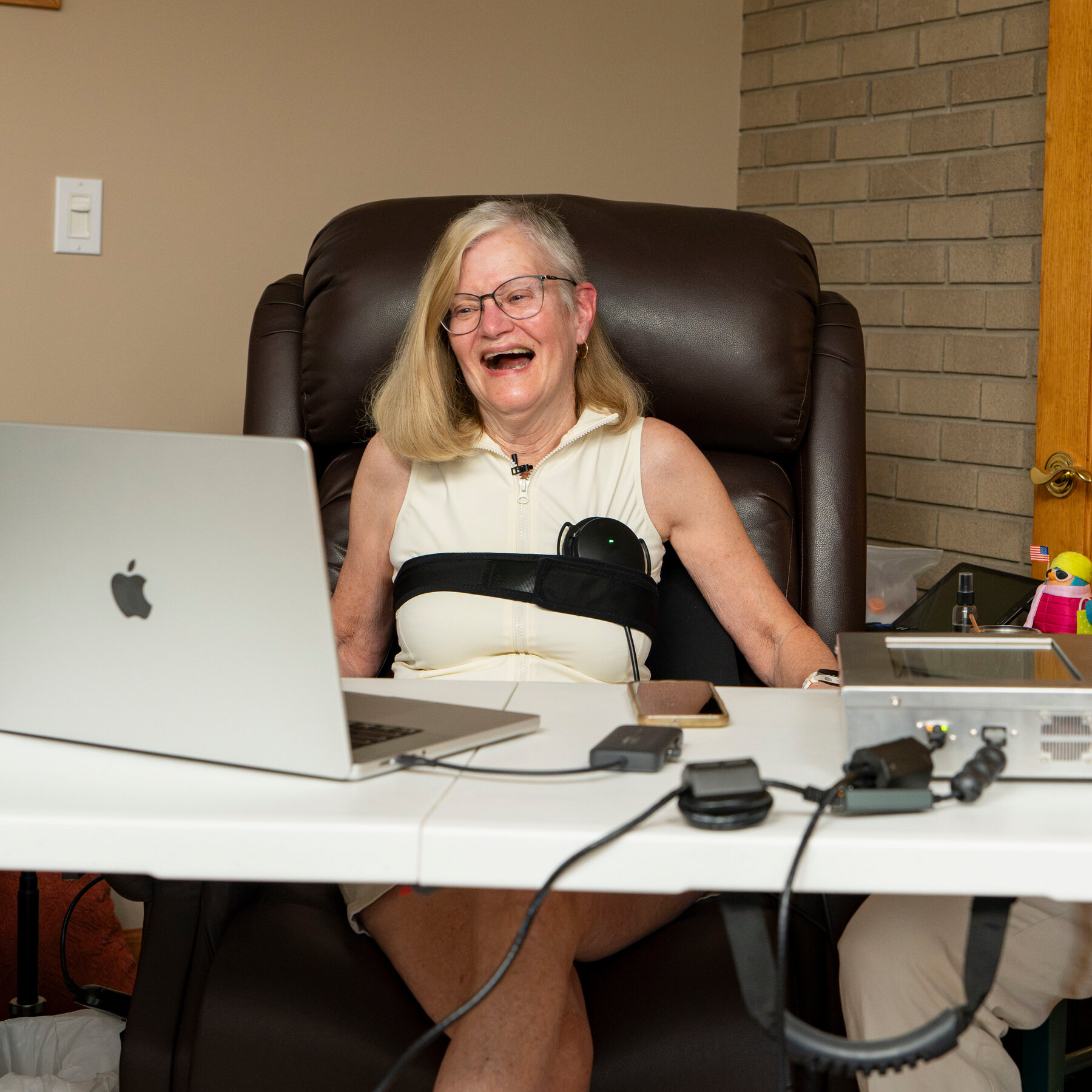
Paradromics’ Connexus brain-computer interface has achieved something that sounds almost impossible: a person with severe speech impairment has used neural activity to generate her own words, answer open-ended questions and have a real-time conversation with her family.
But the most interesting part is not simply that a computer can “read” brain activity.
The real breakthrough is that the system is beginning to close the distance between what a person intends to say and the moment when those words reach another human being.
On September 14, 2026, Paradromics announced that the first participant implanted with its Connexus Brain-Computer Interface (BCI) had successfully used the system for real-time speech and text communication. The participant, a woman in her 60s living with a progressive motor neuron disease, has severe dysarthria and limited natural speech.
Musumeci Online – The Podcast. It is perfect for driving, commuting, or waiting in line!
During the demonstration, she was not simply choosing words from a predefined menu.
She chose what she wanted to say.
She answered open-ended questions.
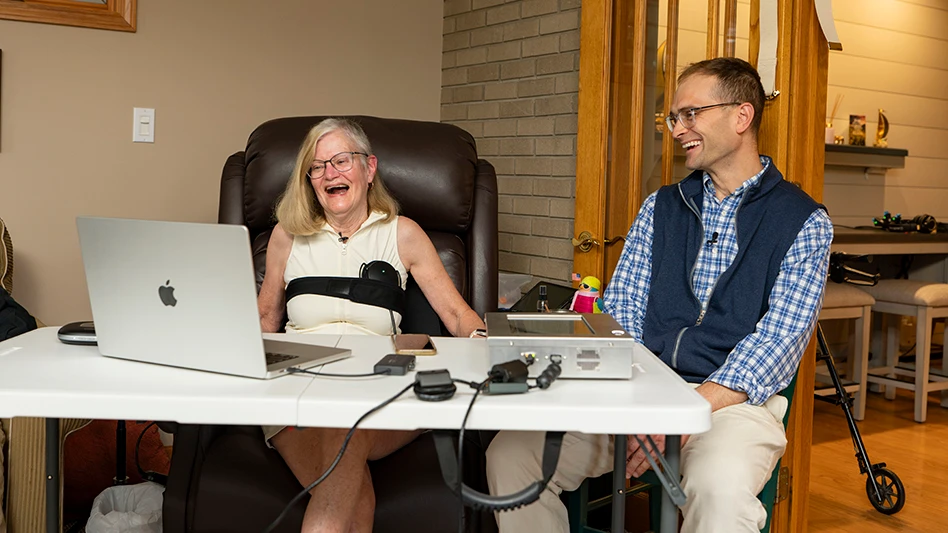
And, during a live phone call, she communicated with her grandchildren.
That distinction may sound small. Technically, it is enormous.
From selecting words to saying what you actually want
One of the easiest ways to understand the evolution of speech BCIs is to think about the difference between sending a message by choosing from a menu and having a normal conversation.
Imagine being given a screen containing 100 possible words. You can communicate, but only by selecting something that someone else has already prepared.
Now imagine being able to say:
“Okay, I have a lot to say.”
without selecting that sentence from a list.
That is much closer to natural communication.
According to Paradromics, this was the first sentence generated by the participant during its free-speech demonstration. The company reports that the sentence was decoded in real time without errors.
She later answered an open-ended question from neurosurgeon Matthew Willsey about what she would say to someone considering participation in a BCI study. The system again generated the words she intended.
These demonstrations are important because open-ended language is much harder to decode than a restricted set of predefined commands.
A system designed to recognise only “yes”, “no”, “left” and “right” has a relatively small problem to solve.
Human language does not.
We can choose almost any word, change the structure of a sentence halfway through, introduce a name, ask a question, tell a joke or suddenly change the subject.
A useful way of thinking about the challenge is the difference between recognising the four buttons on a remote control and understanding everything that someone might say during dinner.
CREDIT: PARADROMICS
The missing link between intention and speech
Speech normally feels effortless because we experience it as a single action.
We decide what we want to communicate, formulate language, prepare the movements required for speech, and our nervous system coordinates the muscles of the tongue, lips, jaw, larynx and respiratory system.
When neurological disease or injury disrupts those pathways, the person may still know exactly what they want to say while being unable to produce intelligible speech.
The message exists.
The communication machinery does not work properly.
Speech BCIs attempt to create a different route.
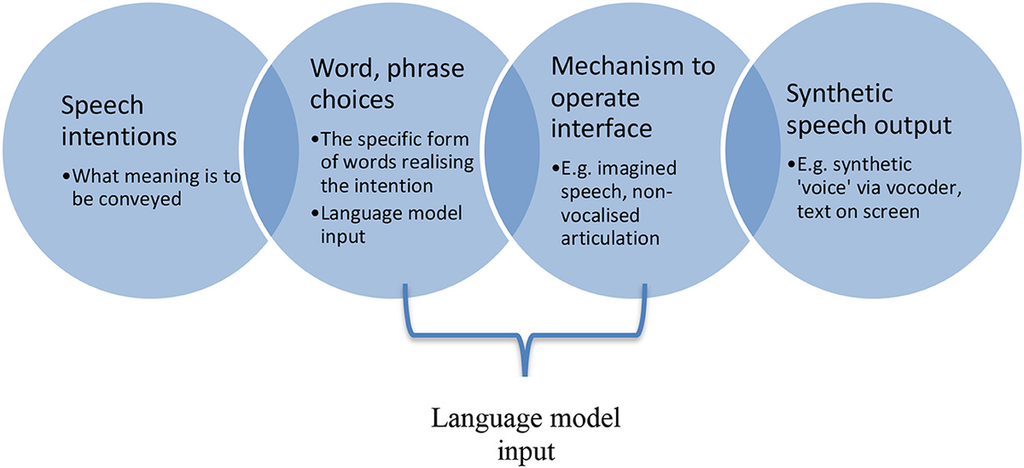
Instead of waiting for the damaged pathway to deliver commands to the muscles, the system records neural activity associated with speech and uses algorithms to infer what the person is attempting to communicate.
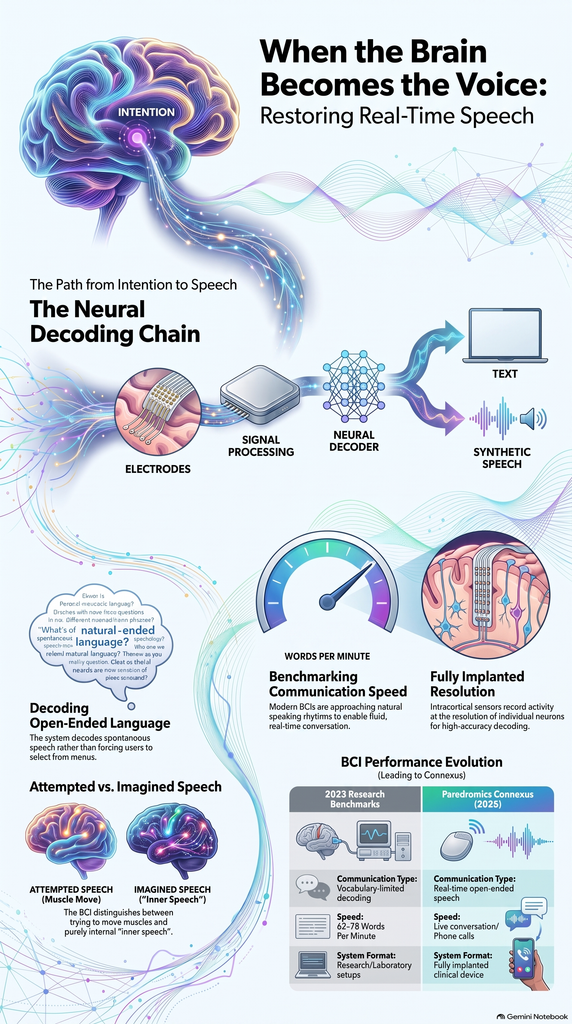
The simplified chain looks something like this:
Intention → neural activity → electrodes → signal processing → neural decoder → language → text or synthetic speech
The important word here is decoder.
The computer is not reading a sentence from a little screen inside the person’s brain. It receives patterns of electrical activity and has to learn how those patterns relate to language.
This is where neuroscience and artificial intelligence meet.
What Connexus is actually listening to
Paradromics describes Connexus as a fully implanted intracortical BCI designed to record neural activity at the resolution of individual neurons.
That matters because neurons do not all respond in exactly the same way.
When someone prepares to speak, attempts to speak, or generates language internally, populations of neurons produce patterns of activity. Those patterns contain information that machine-learning systems can learn to associate with different aspects of communication.
Paradromics says that data from its first participant revealed distinguishable neural patterns associated with several states:
- listening to language;
- preparing to speak;
- attempting speech;
- and generating speech internally.
This last distinction is particularly interesting.
It moves the conversation beyond simply detecting the movements a person is trying to make with their mouth.
Attempted speech versus imagined speech
There is an important difference between attempted speech and imagined speech.
Attempted speech means that a person tries to speak. Their brain generates commands associated with speech, even if the muscles cannot produce intelligible sounds.
Imagined speech goes a step further.
You can silently formulate a sentence in your head without moving your mouth or producing a sound. That internal voice is often described as inner speech, imagined speech or covert speech.
These concepts overlap, but they are not identical.
A 2026 review of imagined-speech BCIs highlighted exactly this problem: researchers are not dealing with one single decoding task. Studies can attempt to identify semantic intentions, phonemes, words or complete sentences, while the output may be a limited set of commands, text or synthetic speech.
That distinction is crucial when we hear that a BCI can “read thoughts”.
The phrase is convenient, but scientifically misleading.
Today’s speech BCIs are not universal mind readers.
They are highly specialised systems trained to extract particular types of information from neural activity under defined conditions.
That difference will become increasingly important as these technologies move from laboratories towards clinical use.
The AI inside the loop
There is another reason speech BCIs are fascinating: the implant alone is not the whole system.
The electrodes collect neural signals. But those signals need to be interpreted.
This is where machine learning enters the picture.
Earlier generations of speech neuroprostheses demonstrated that neural activity could be translated into language at increasingly useful speeds. In 2023, for example, researchers reported an intracortical system capable of decoding attempted speech at an average of 62 words per minute, using a vocabulary of 125,000 words. Another system using high-density surface recordings reached a median of 78 words per minute in a participant with severe paralysis.
Those numbers were important because they moved speech BCIs closer to the rhythm of real communication.
But speed is only one part of the problem.
A person does not communicate simply by producing words quickly. Communication requires flexibility, accuracy, timing and the ability to express something that was not anticipated by the system designer.
This is why the transition towards open-ended, real-time communication is so significant.
Why the word “real-time” matters
Suppose a BCI can decode a sentence correctly, but it takes 30 seconds to produce it.
That could still be extremely useful.
But it would feel very different from a conversation.
Now imagine that the system can interpret the user’s intended language quickly enough for a question and answer to flow naturally.
The technology begins to behave less like a typing aid and more like a communication channel.
That is the direction suggested by the Paradromics demonstration.
The participant was able to communicate with her grandchildren during a live phone call, using speech generated through the BCI.
For someone whose natural speech has become extremely difficult to understand, this is not simply a technical benchmark.
It changes the social experience of communication.
The difference between being able to communicate and being able to participate in a conversation can be enormous.
A new chapter after the breakthroughs of 2023
This development is easier to appreciate if we look briefly at where the field has come from.
In 2023, several landmark studies demonstrated that cortical activity could be decoded into language at speeds and vocabularies far beyond earlier BCI systems.
One Nature study achieved 62 words per minute with a 125,000-word vocabulary.
Another demonstrated text, synthetic speech and control of a facial avatar, reaching 78 words per minute for text.
Those studies showed that high-resolution neural recordings combined with sophisticated machine-learning models could extract surprisingly rich information about intended speech.
In 2024, another important study demonstrated an instantaneous voice-synthesis neuroprosthesis for a man with ALS, producing speech that was designed to resemble his pre-ALS voice.
The field therefore already had an impressive scientific foundation.
Connexus adds another piece to the picture: a fully implanted system being used for free, self-generated communication in real time.
That is the new element we should pay attention to.
And where does Neuralink fit?
Neuralink is also moving into speech restoration.
Its current clinical programme describes the N1 implant as an investigational BCI intended to help people with severe speech impairment produce verbal thought as text or directly as speech.
But there is no need to retell that story here.
The more interesting observation is that different companies and research groups are converging on a similar clinical objective: using neural signals to bypass damaged communication pathways.
The engineering approaches, electrode systems, decoding strategies and clinical programmes are not necessarily identical.
What they share is a much more fundamental idea:
the brain may still contain the information required for communication even when the body can no longer deliver that information to the outside world.
That is where speech BCIs could become transformative.
From restoring speech to connecting the brain with AI
Paradromics is already thinking beyond speech.
The company describes Connexus as a platform intended eventually to support computer control, movement, prosthetics and other applications. Its CEO has also described the technology as a potential conduit between human intention and AI.
That idea deserves both excitement and caution.
Today, using a BCI to help someone communicate is a concrete medical objective.
Directly interacting with AI through neural signals is a much broader technological possibility.
Imagine a future in which a person with severe paralysis could formulate a request without moving a finger:
“Help me write a message to my daughter.”
The BCI could decode the intended language.
An AI system could help structure the message.
The user could review it through an appropriate interface.
And the final communication could be delivered through synthetic speech.
In that scenario, the BCI is not replacing the person’s intention.
It is removing a physical barrier between intention and action.
That distinction may become one of the most important principles in the development of neurotechnology.
The difficult questions are just beginning
The progress is remarkable, but it is important not to confuse a successful early demonstration with a finished medical product.
Connexus remains an investigational device, and the current results come from an early feasibility study involving the first participant.
Researchers still need to understand how reliably these systems perform across different people, diseases and stages of neurological impairment.
They also need to study long-term stability.
An implant intended to remain in the brain for years cannot be evaluated only by how well it works during a successful demonstration.
There are questions about surgery, biocompatibility, signal stability, calibration, decoder adaptation, usability and the practical demands placed on patients and caregivers.
There is also a fascinating biological question.
Paradromics reports that it is observing how neural patterns evolve as the participant listens, prepares to speak, attempts speech and generates language internally.
If these patterns change over time, the decoder may need to adapt.
In other words, the future BCI may not simply be a machine that learns the brain.
The brain and the machine may learn each other.
The real breakthrough is not reading thoughts
The most compelling aspect of this technology is therefore not the science-fiction idea of a machine reading someone’s mind.
It is something much more human.
A person can know exactly what they want to say and still be unable to say it.
A speech BCI attempts to create another route from that intention to another human being.
That is why the sentence “I have a lot to say” carries more weight than a technical benchmark.
The technology is impressive because it records neural activity from hundreds of channels, processes complex biological signals and uses machine learning to reconstruct language.
But the medical value is much simpler to understand.
Someone has something to say — and technology is beginning to give that person a new way to say it.
Paradromics’ achievement is another step in a much larger journey: from decoding neural signals to restoring lost functions, and perhaps eventually to creating entirely new ways for humans to interact with machines.
The brain may not need a new language.
Perhaps technology simply needs to learn how to listen.
A note on the technology
It is worth keeping one distinction in mind when discussing speech BCIs.
“Brain-to-speech” does not mean “thought-to-anything.”
Current systems are designed around specific neural signals, specific recording technologies and specific decoding tasks. Their capabilities are the result of extensive training and calibration, and they remain experimental.
The closer these systems get to natural communication, however, the more important that distinction becomes — not because it makes the technology less exciting, but because it helps us understand what has actually been achieved.
Leave a Reply