
What if doctors could control a specific group of nerve cells using nothing more than a beam of light?
It sounds like science fiction. But this is remarkably close to what a technology called optogenetics has made possible in neuroscience.
Musumeci Online – The Podcast. It is perfect for driving, commuting, or waiting in line!
In 2026, the Nobel Prize in Physiology or Medicine was awarded to Karl Deisseroth, Peter Hegemann and Georg Nagel for their discoveries concerning light-gated ion channels and optogenetics. Their work transformed a curious biological phenomenon found in microscopic algae into one of the most powerful tools ever developed for studying the living brain.

But why does shining light on a neuron matter?
Because the brain is not simply a collection of cells. It is an extraordinarily complex network in which electrical signals travel between billions of neurons. For decades, neuroscientists could observe what happened when this network was disturbed or stimulated, but they often struggled to answer a much more important question:
Which specific cells actually cause a particular behaviour, sensation or memory?
Optogenetics changed the question from “What happens when we interfere with the brain?” to something much more precise:
“What happens if we control these particular neurons, at this particular moment?”
And that difference could have enormous consequences for the future of medicine.
A Nobel Prize born from an unexpected place
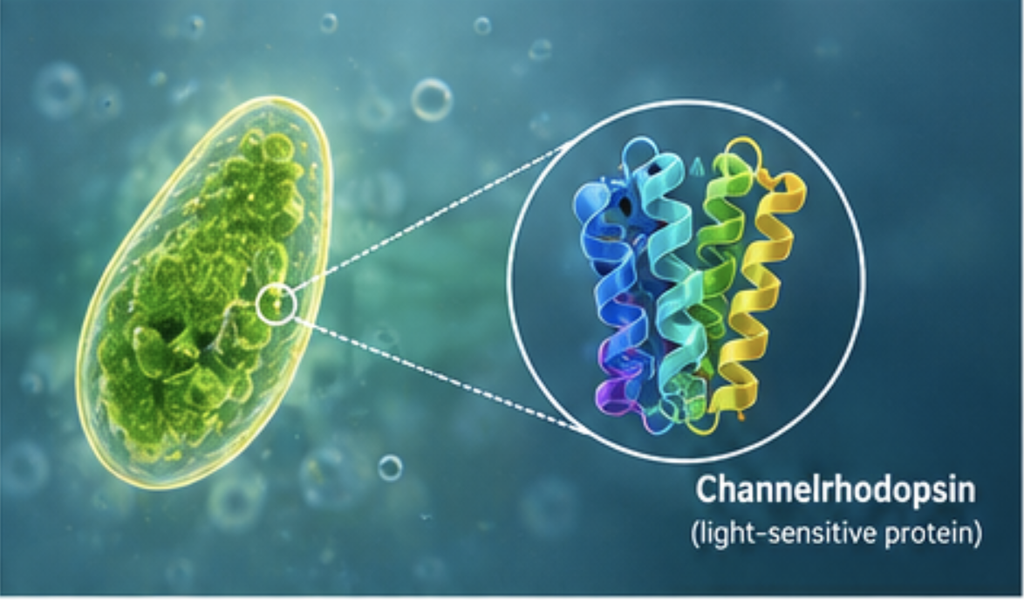
The story begins somewhere that seems very far away from a human brain: a single-celled alga.
Some microorganisms have evolved an extraordinary ability. They can detect light and use that information to move towards it.
Peter Hegemann and Georg Nagel studied this phenomenon and helped uncover the molecular mechanism behind it: special proteins known as channelrhodopsins.
These proteins sit in the cell membrane and behave somewhat like tiny molecular doors.
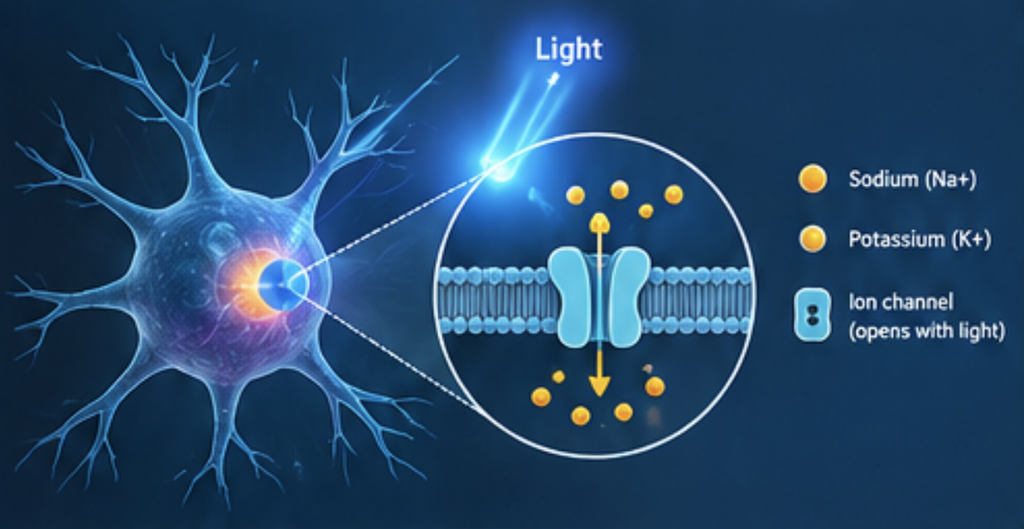
When light of the right wavelength hits them, the door opens.
Charged particles can then flow through the membrane, changing the electrical state of the cell.
That discovery provided something neuroscience had been missing: a way of converting light into an electrical signal inside a living cell.
At this point, the connection with the brain might still seem mysterious.
Then came Karl Deisseroth.
Turning a biological curiosity into a neural switch
Neurons communicate largely through electrical signals.
When a neuron becomes sufficiently activated, it generates an electrical impulse known as an action potential. This signal can travel along the neuron and influence other cells.
Think of a neuron as a tiny electrical switch.
The problem for neuroscientists is that the brain contains an enormous number of these switches, connected in complicated circuits.
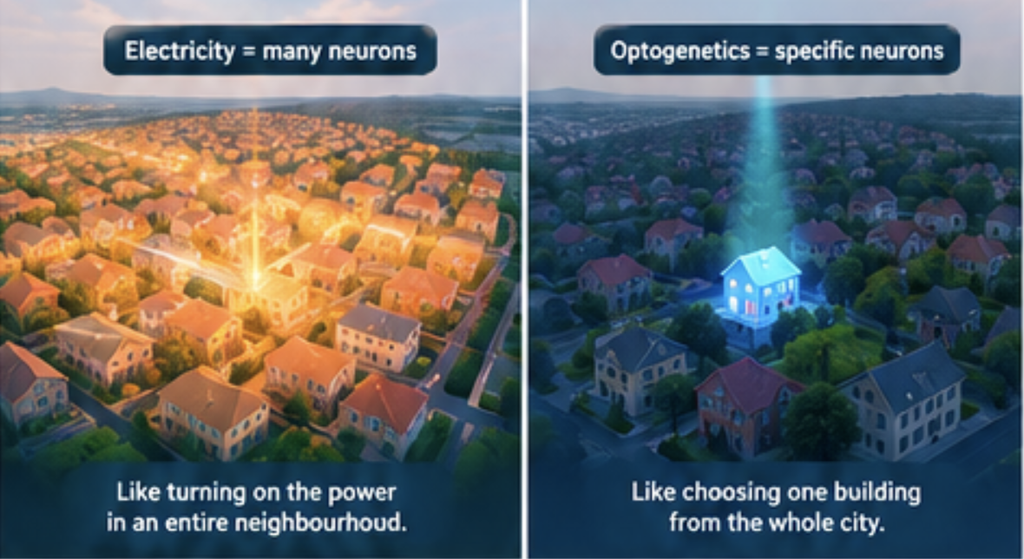
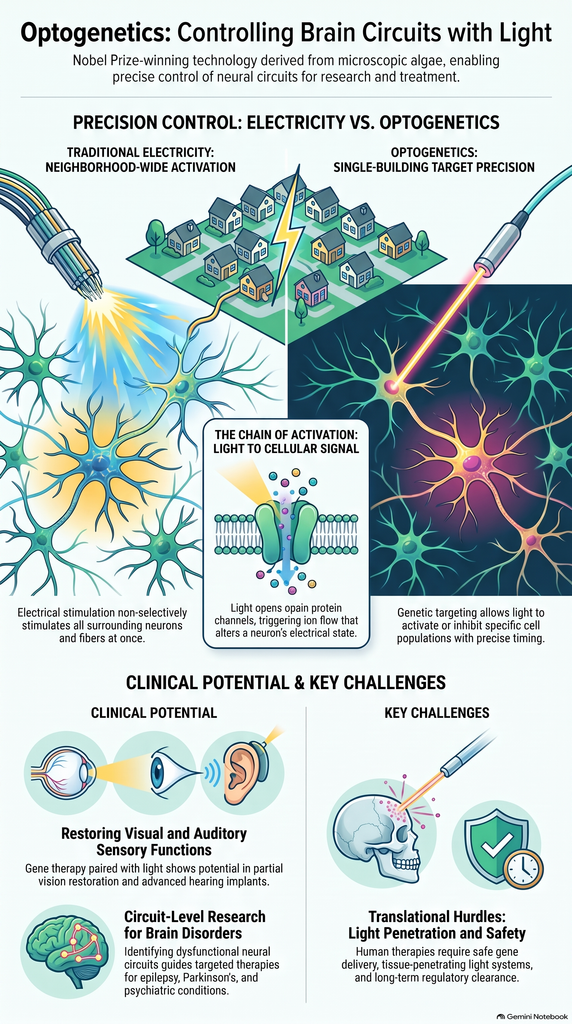
If you stimulate a large region of the brain electrically, you may activate many different neurons at once.
It is a little like trying to understand a city by switching the electricity on and off for an entire neighbourhood.
You can certainly see that something happens.
But you cannot easily tell which individual building caused it.
Optogenetics offered something much more precise.
Deisseroth and colleagues introduced the gene for a light-sensitive protein into selected nerve cells. Those neurons could then respond to light.
Now researchers could shine light on the targeted cells and activate — or, with other light-sensitive proteins, inhibit — their activity.
The result was effectively a remote control for selected populations of neurons.
This was demonstrated in neuronal cells and subsequently in living animals, opening a completely new way to investigate how neural circuits produce behaviour.
Why controlling neurons is so important
Imagine that you are trying to understand why pressing a particular button on a machine makes it move.
One approach would be to hit the entire machine with a hammer and observe what happens.
You might learn something.
But imagine instead that you could remotely control one component at a time.
That is much closer to what optogenetics brought to neuroscience.
Researchers can target particular types of neurons and activate or inhibit them with extraordinary timing and spatial precision.
This makes it possible to investigate questions that were previously extremely difficult to answer.
Which neurons are involved in fear?
Which ones contribute to reward?
Which neural circuits control movement?
Which cells participate in forming a memory?
And perhaps most importantly:
Which neurons are actually responsible for a behaviour, rather than simply being active at the same time?
That last distinction is crucial.
Correlation tells us that two things happen together.
Optogenetics can help investigate causality: whether changing the activity of a particular group of cells actually changes the behaviour.
This has helped scientists investigate neural circuits involved in memory, emotion, motivation, movement and neurological and psychiatric disorders.
From observing the brain to testing its circuits
This is one of the most important conceptual changes brought by optogenetics.
For a long time, neuroscience was largely an observational science.
Researchers could record electrical activity, examine brain anatomy or observe behaviour.
But observation alone has limits.
If two groups of neurons become active when someone experiences fear, for example, we still need to know whether those neurons are actually producing the response or merely participating in it.
Optogenetics allows researchers to intervene in the circuit.
In animal experiments, scientists have used this approach to activate specific neural populations and observe changes in behaviour. They have also used it to reactivate particular neural ensembles associated with experiences such as fear.
In simple terms, neuroscience gained something resembling an experimental remote control.
And that changed the kinds of questions researchers could ask.
But how does light actually control a neuron?
Here is the technical part — without making it unnecessarily complicated.
Neurons maintain an electrical difference between the inside and outside of their cell membrane.
This electrical state depends partly on charged particles, or ions, such as sodium and potassium.
Normally, ion channels in the membrane open and close in response to biological signals.
Optogenetics adds a new kind of control.
Scientists can introduce genes that make selected cells produce light-sensitive proteins called opsins.
When the appropriate wavelength of light reaches the opsin, it changes the flow of ions across the cell membrane.
That changes the neuron’s electrical state.
Depending on the specific opsin, the neuron can become more likely to fire or less likely to fire.
The chain is therefore surprisingly simple:
Light → light-sensitive protein → ion flow → electrical change → neuronal activity
That is the fundamental idea behind optogenetics.
And it is one reason the discovery of light-gated ion channels was so important.
Why not just use electricity?
This is where the technology becomes particularly interesting.
Electrical stimulation is already extremely useful in medicine.
Deep brain stimulation, for example, can deliver electrical pulses to specific brain regions and is an established treatment for some neurological disorders.
But electrical current does not naturally respect the boundaries between different types of neurons.
It can stimulate several nearby cells and fibres at once.
Light can potentially be much more selective.
With the right combination of genetic targeting and optical delivery, researchers can aim to control particular cell populations rather than simply stimulating everything nearby.
This high degree of spatial and temporal precision is one of optogenetics’ defining advantages.
In other words, electricity is somewhat like turning up the volume in a room.
Optogenetics aims to give researchers something closer to choosing which instrument in the orchestra should play, and exactly when.
From neuroscience laboratory to medicine
This is where the Nobel Prize becomes particularly relevant to healthcare.
The discovery itself is fundamental science.
But fundamental science can eventually change clinical medicine in two different ways.
The first is indirect.
By using optogenetics in research, scientists can identify which neural circuits are involved in disease.
That knowledge can then guide other treatments that do not use optogenetics directly.
For example, researchers may discover that a particular population of neurons contributes to a disease mechanism. Future drugs, electrical stimulation devices or other therapies can then be designed around that biological knowledge.
Recent research has highlighted this indirect route as an important part of optogenetics’ potential clinical impact.
The second route is more ambitious:
using optogenetics itself as a therapy.
And this is already moving beyond pure theory.
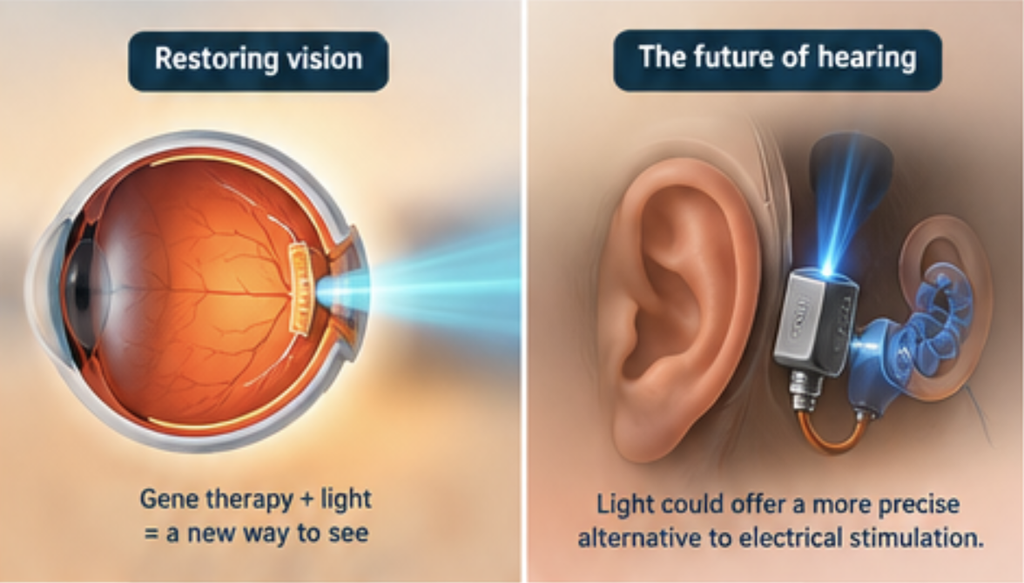
Could light help restore sight?
One of the most striking examples involves vision.
In some forms of retinal degeneration, the photoreceptor cells that normally detect light are lost or severely damaged.
But other retinal neurons may remain alive.
Researchers have explored whether those surviving cells could be genetically modified to become sensitive to light.
In 2021, a clinical report described a blind patient with retinitis pigmentosa who received an optogenetic treatment designed to make retinal ganglion cells light-sensitive. The patient used specially engineered goggles that detected changes in the visual environment and projected corresponding light patterns onto the retina.
The patient was subsequently able to perceive, locate, count and touch certain objects using the treated eye while wearing the goggles.
This was not a restoration of normal vision.
And that distinction matters.
But it demonstrated something extraordinary:
A biological system that had lost its normal ability to detect light could be partially connected to the visual world again using gene therapy and light.
That is an important proof of principle.
And what about hearing?
The same principle could potentially be applied to the auditory system.
Today, cochlear implants use electrical stimulation to activate the auditory nerve.
They can provide remarkable benefits, but electrical current spreads through tissue, limiting how precisely different neural populations can be stimulated.
Optogenetic cochlear implants are being investigated as a possible alternative.
The idea is to make selected auditory neurons sensitive to light and then use carefully controlled light stimulation to activate them.
Because light can potentially be confined more precisely than electrical current, researchers hope that this could eventually allow more detailed stimulation of the auditory nerve and potentially improve aspects of artificial hearing.
This remains an experimental field, not a replacement for today’s cochlear implants.
But the principle is fascinating:
Instead of sending electricity into the nervous system, could we one day communicate with it using light?
The bigger medical opportunity: controlling circuits, not just cells
Vision and hearing are relatively intuitive examples.
The much larger question is whether the same principle could eventually help us influence dysfunctional neural circuits involved in neurological and psychiatric disease.
Researchers are investigating neural circuits associated with conditions including epilepsy, Parkinson’s disease, addiction and psychiatric disorders.
But there is an important distinction here.
Optogenetics has already become an extremely powerful research technology.
Its direct therapeutic use in humans is much less mature.
A 2025 Nature Neuroscience perspective described optogenetics as having transformed basic research while also highlighting the considerable scientific, engineering, safety and regulatory challenges involved in translating it into human therapies.
Those challenges are substantial.
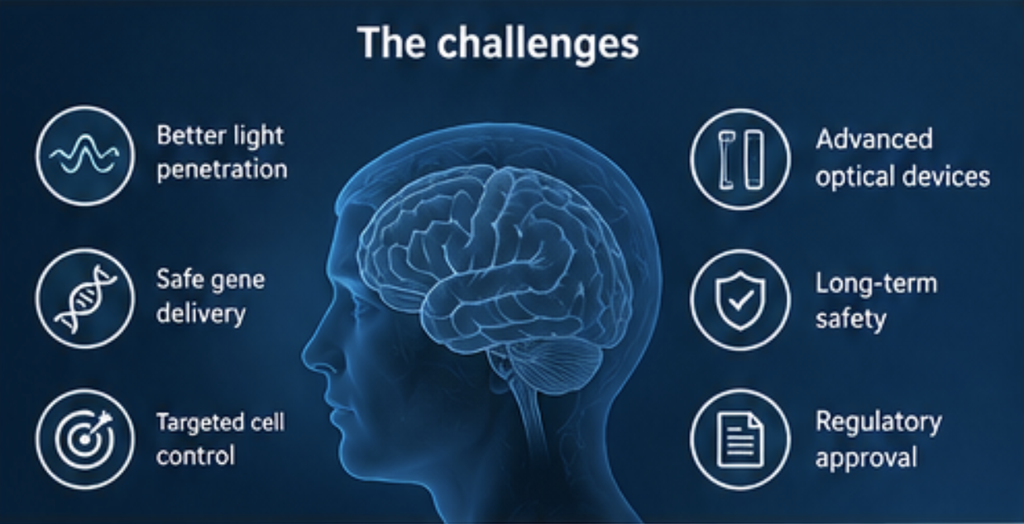
The human brain is not a mouse brain scaled up.
Light does not travel easily through brain tissue.
Gene delivery has to be safe and sufficiently precise.
Researchers need to control which cells become light-sensitive.
Implantable optical systems may be required for some applications.
And any permanent biological modification raises questions about long-term safety.
These are not minor engineering details.
They are part of the central medical challenge.
The future may not look like a science-fiction brain
It is tempting to imagine a future in which doctors simply shine a light into someone’s head and switch neurons on and off.
That is not where we are.
Current optogenetic systems often require a combination of genetic modification and specialised light-delivery technology. In many experimental applications, optical fibres or implanted devices are necessary because light has limited penetration through tissue.
The future could therefore depend as much on engineering as on biology.
Researchers are working on more sensitive opsins, wavelengths that penetrate tissue more effectively, improved gene-delivery strategies and wireless or minimally invasive optical systems.
The ultimate goal is not simply to make neurons respond to light.
It is to make the whole system precise, safe, controllable and clinically useful.
A new language for talking to the brain
Perhaps the most interesting way to understand the 2026 Nobel Prize is not as the discovery of a particular protein.
It is as the creation of a new way of communicating with living cells.
For centuries, medicine has mainly worked through a limited set of languages.
We use molecules through drugs.
We use physical forces through surgery.
We use electricity through devices such as pacemakers and neurostimulators.
Optogenetics adds another possibility:
light as a biological control signal.
That is a profound change in perspective.
A beam of light is normally something we associate with seeing.
Optogenetics turns it into something that can also become an instruction for a cell.
And once biology becomes programmable in this way, the possibilities extend beyond neuroscience.
Researchers are exploring optogenetic approaches in other biological systems, while advances in light-sensitive proteins, gene delivery and optical technologies continue to expand what can be controlled.
The real legacy of the 2026 Nobel Prize
The story of optogenetics is remarkable because it connects several worlds that would normally seem unrelated.
A microscopic alga.
A light-sensitive protein.
A gene.
A neuron.
A beam of light.
And eventually, perhaps, a medical treatment.
The Nobel Prize awarded to Karl Deisseroth, Peter Hegemann and Georg Nagel recognises the scientific discoveries that made this chain possible.
But its importance goes beyond the technology itself.
Optogenetics has given neuroscience a way to move from simply watching the brain to testing its circuits with unprecedented precision.
And medicine may eventually benefit from that knowledge.
Perhaps one day, treatments for neurological disease will not simply suppress symptoms across large areas of the nervous system.
Perhaps they will target specific dysfunctional circuits.
Perhaps electrical stimulation will increasingly be complemented by biological and optical interfaces.
Perhaps some forms of blindness or hearing loss will be approached not only by replacing damaged hardware, but by teaching surviving cells to respond to a new kind of signal.
We are not there yet.
But the direction is already visible.
The 2026 Nobel Prize in Physiology or Medicine reminds us that some of the most transformative medical technologies begin with questions that initially appear almost absurd:
What if a cell could see light?
And what if, once we learned how to make it see light, we could use that light to talk to it?
That is the extraordinary journey behind optogenetics — and perhaps one of the most fascinating glimpses yet of how medicine could learn to communicate with the nervous system.
Leave a Reply