
Not long ago, losing the ability to speak meant losing one of the most essential parts of human connection.
Today, that reality is starting to change.
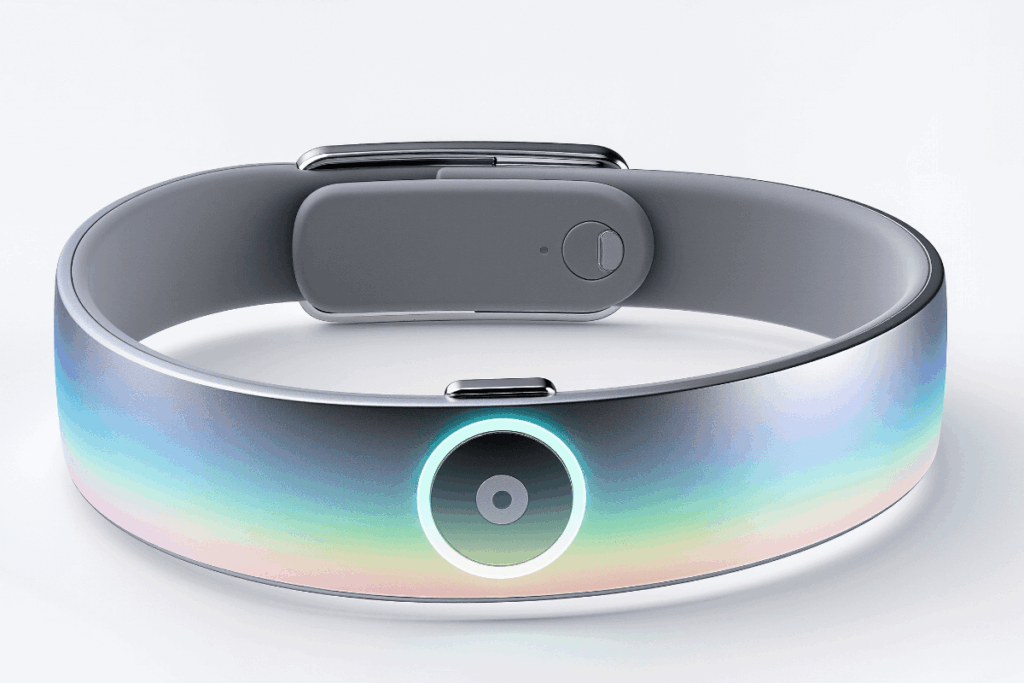
Researchers have developed what is now called a “wearable intelligent throat”—a soft, lightweight device that sits around the neck and can transform silent movements into natural, fluent speech.
It may sound like science fiction. Yet early results suggest it could redefine how we understand communication in medicine.
Musumeci Online – The Podcast. It is perfect for driving, commuting, or waiting in line!
Why losing speech is more than a medical issue
Speech is not just about words. It is about identity, relationships, and independence.
Conditions such as stroke, Parkinson’s disease, or ALS can damage the muscles that control speech, leading to a condition called dysarthria. In simple terms, the brain knows what it wants to say, but the body cannot express it clearly.
To put this into perspective:
- Imagine trying to send a message with a broken keyboard
- Or attempting to have a conversation where every word takes seconds to produce
That is the daily reality for millions of people worldwide.
Traditional solutions—like typing systems controlled by eye movements—work, but they are often slow and exhausting.
The intelligent throat offers something different: a more natural, fluid way to communicate.
How the intelligent throat actually works
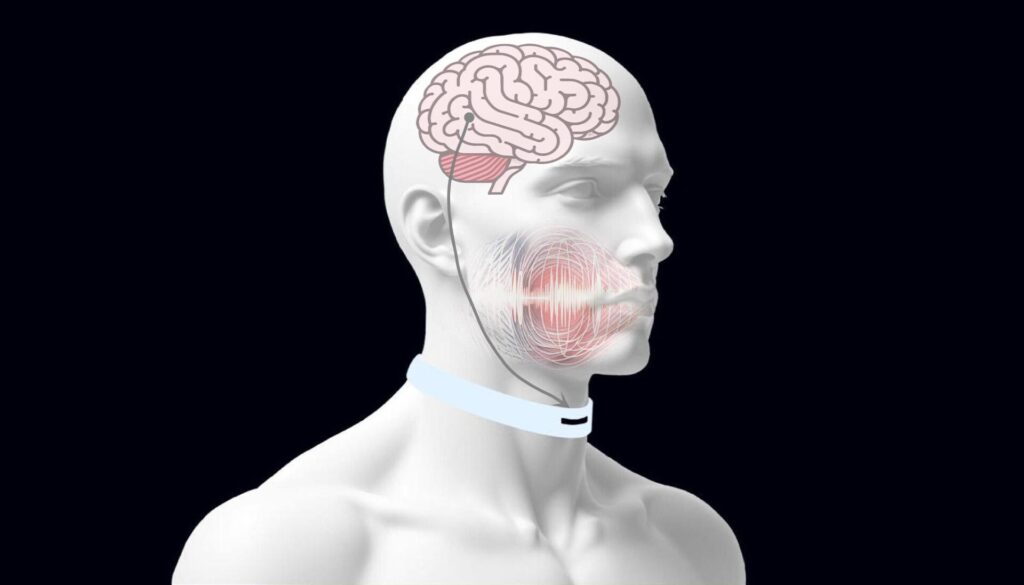
Instead of listening to your voice, this device listens to your body.
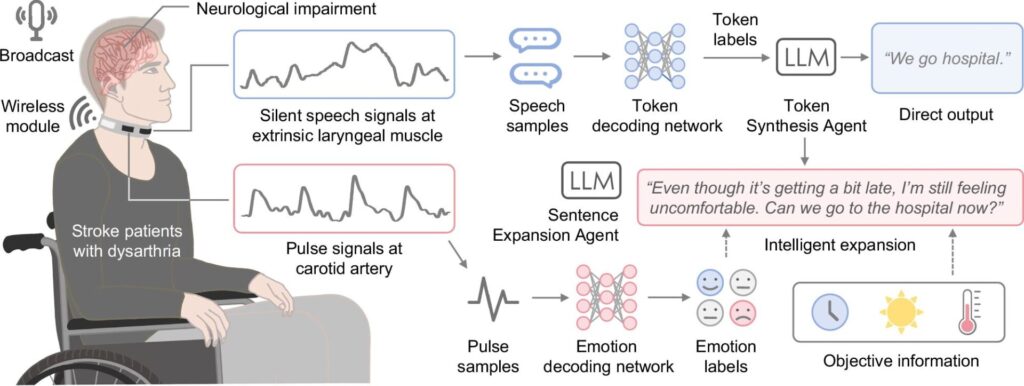
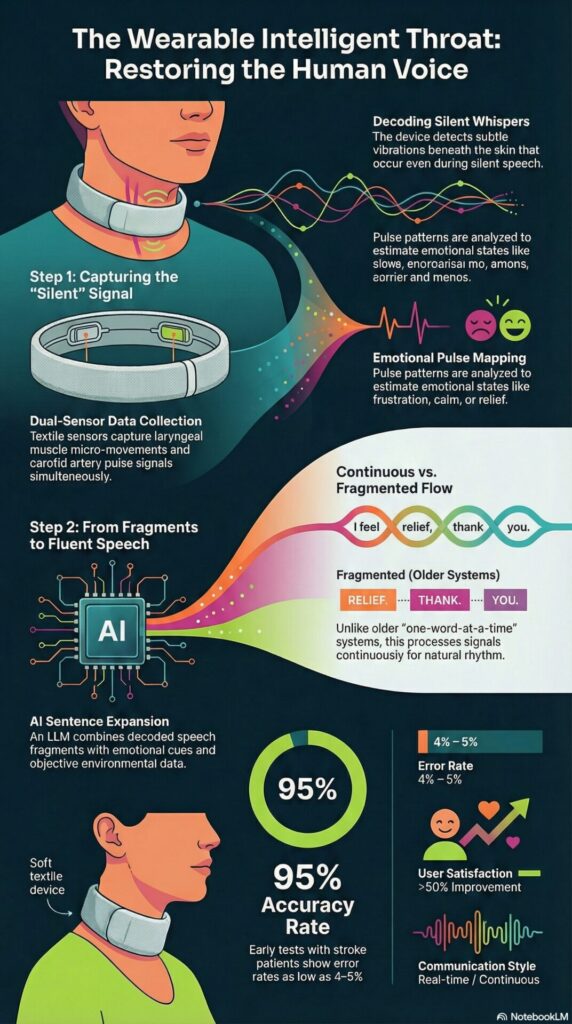
When we try to speak—even silently—tiny muscles in the throat still move. These movements create subtle vibrations, almost like whispers beneath the skin.
The wearable intelligent throat captures these signals using ultra-sensitive textile sensors embedded in a soft fabric.
At the same time, it also detects signals from the body such as pulse patterns, which can reveal emotional states.
Then comes the most fascinating part:
- Artificial intelligence processes all this information in real time
- It reconstructs words from micro-movements
- It refines them into complete, natural sentences
Think of it as turning intention into language.
From fragments to fluent speech
Earlier technologies often worked like old messaging systems: one word at a time, with pauses in between.
The intelligent throat takes a different approach.
Instead of waiting for full words, it breaks signals into tiny fragments—like letters in a sentence—and processes them continuously.
This allows users to communicate in a way that feels closer to natural speech.
Even more impressive, AI models can:
- Correct small errors automatically
- Fill in missing parts of a sentence
- Adapt tone based on emotional signals
In tests with stroke patients, this approach achieved:
- Very low error rates (around 4–5%)
- Over 50% improvement in user satisfaction
In everyday terms, that is like going from a frustrating conversation full of interruptions to one that feels smooth and expressive.
When AI understands not just words, but emotions
Communication is not only about what we say—it is also about how we say it.
One of the most innovative aspects of this technology is its ability to detect emotional cues.
By analyzing pulse signals from the neck, the system can estimate whether a person feels:
- calm
- relieved
- frustrated
This information helps the AI generate sentences that better reflect the user’s intent.
For example:
Instead of producing a neutral sentence like
→ “I am fine”
It could adapt to something closer to
→ “I’m feeling much better today”
That subtle difference can completely change how a message is perceived.
Real-world applications: beyond the laboratory
This is not just a theoretical concept.
Recent studies and demonstrations show that wearable speech systems are moving closer to real-world use.
Potential applications include:
1. Stroke rehabilitation
Helping patients regain communication during recovery, often one of the biggest emotional challenges.
2. Neurodegenerative diseases
Supporting people with conditions like ALS or Parkinson’s as speech abilities decline over time.
3. Hospitals and long-term care
Allowing patients to communicate more easily with doctors and caregivers.
4. Everyday life
Enabling users to interact with family, work, and society more independently.
In the future, this technology could even integrate with smartphones or augmented reality systems, making communication seamless across digital environments.
A broader trend: the rise of “invisible interfaces”
The intelligent throat is part of a much larger transformation.
Healthcare technology is moving toward what we might call “invisible interfaces”:
- Devices that do not interrupt daily life
- Systems that understand the body directly
- AI that translates biology into meaningful information
Similar trends can be seen in:
All of them share the same goal: making technology feel less like a tool and more like an extension of the human body.
Challenges and what comes next
Like any emerging technology, the intelligent throat still faces important challenges:
- Expanding to more languages and accents
- Improving accuracy across different patients
- Ensuring comfort for long-term use
- Scaling for widespread clinical adoption
However, progress is rapid.
Researchers are already working on:
- Smaller, more flexible designs
- Better AI models trained on diverse populations
- Fully portable systems that work without external devices
The direction is clear: from experimental prototype to everyday medical tool.
When technology restores something deeply human
Every major technological leap in medicine aims to solve a problem.
But some go further.
They restore something fundamental.
The ability to speak is not just a function. It is how we share ideas, express emotions, and connect with others.
The wearable intelligent throat does not just decode signals.
It helps people be heard again.
And in a world increasingly shaped by artificial intelligence, that may be one of the most human outcomes of all.
Leave a Reply