Technology is increasingly helping doctors and researchers understand the human body in ways that were impossible just a few years ago. From robotic surgery to AI-powered diagnostics, innovation is opening new frontiers in healthcare. One of the most fascinating developments comes from the intersection of artificial intelligence and biomechanics: a digital platform called MyoSuite.
Musumeci Online – The Podcast. It is perfect for driving, commuting, or waiting in line!
This technology allows scientists to simulate human muscles, joints, and movements inside a computer with remarkable precision. The result is something that feels almost like a “virtual laboratory” for the human body—where doctors, engineers, and researchers can test treatments, design prosthetic limbs, and explore rehabilitation techniques before trying them on real patients.
In simple terms, MyoSuite could help answer one of the most complex questions in medicine: how does the brain control the body, and how can we restore that control after injury?
A Digital Twin of Human Movement
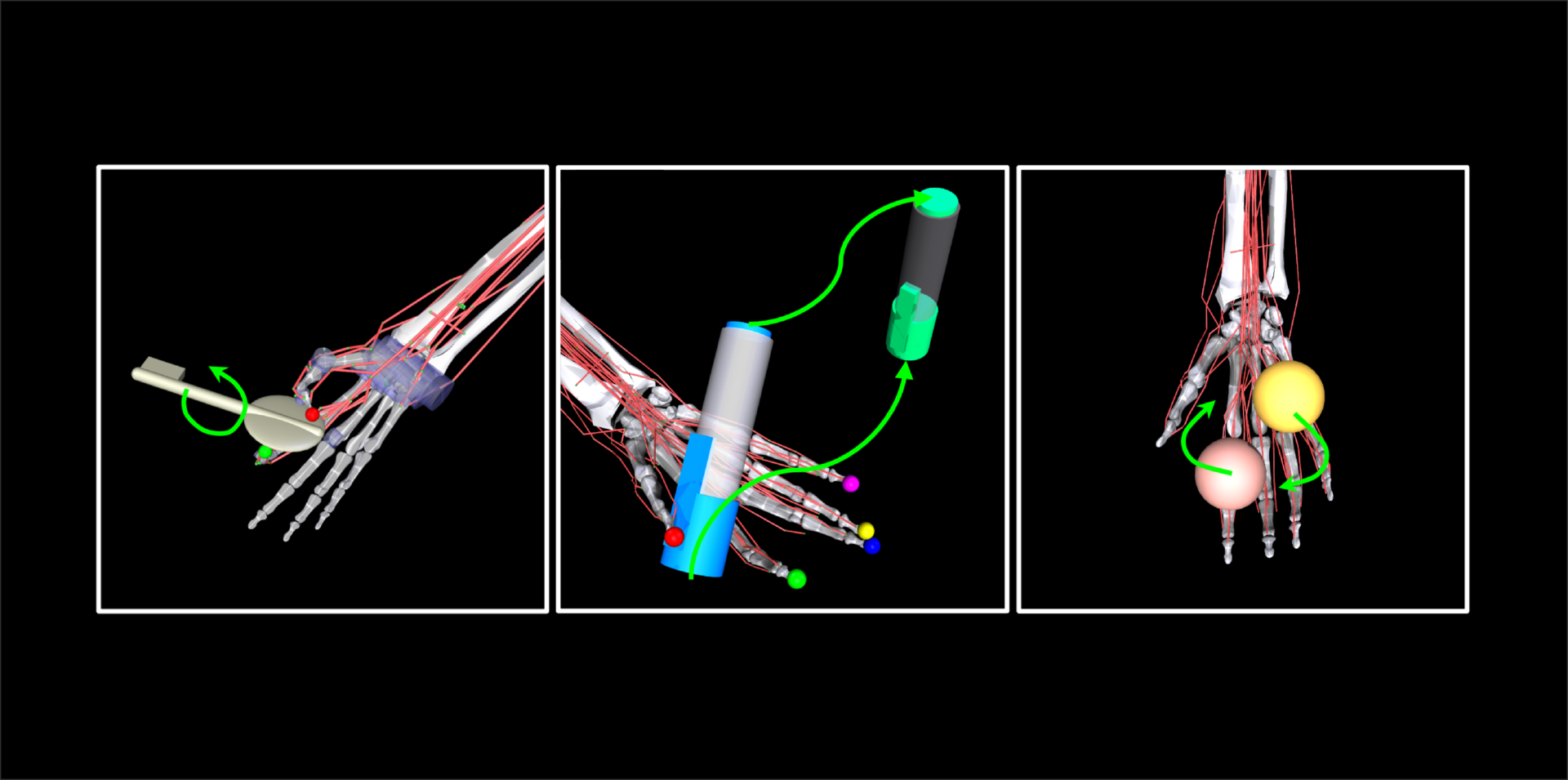
At its core, MyoSuite is a simulation platform that recreates the way muscles and joints work together to produce movement. If you lift a cup of coffee, rotate a key, or write with a pen, dozens of muscles coordinate in a precise sequence.
Replicating this process in software is extremely challenging. The human arm alone contains many muscles, tendons, and joints interacting simultaneously. Imagine an orchestra where every musician must play at the right moment for the music to sound correct. In the body, muscles act like those musicians.
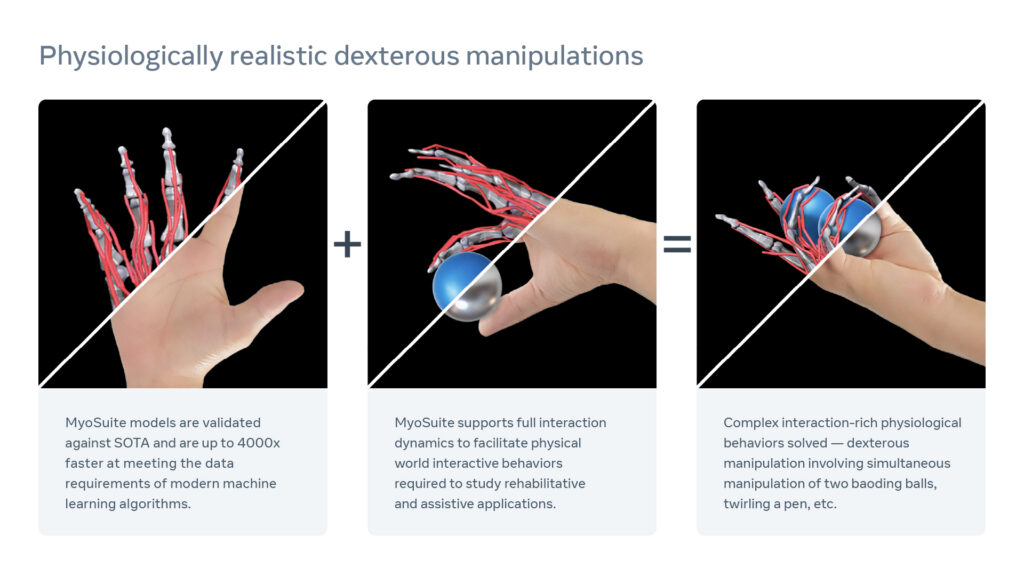
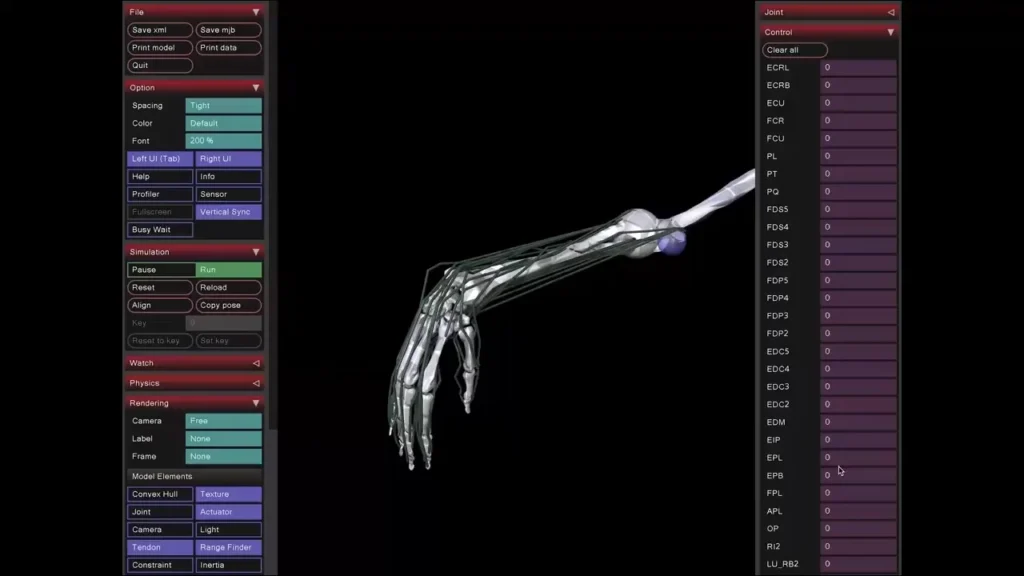
MyoSuite uses artificial intelligence and physics-based models to simulate this coordination. The system can recreate movements involving fingers, hands, and elbows—areas that require extraordinary precision.
Even simple actions can be surprisingly complex. For example:
- Turning a key in a lock
- Twirling a pen between fingers
- Rotating two small balls in the hand (a classic dexterity exercise)
These movements require dozens of tiny muscle adjustments every second. MyoSuite allows AI systems to learn how to perform these actions inside a digital environment.
4,000 Times Faster Than Previous Simulations
One of the reasons MyoSuite is attracting attention in the scientific community is speed.
Traditional biomechanical simulations are slow and computationally heavy. Running detailed models of muscles and joints can take hours or even days.
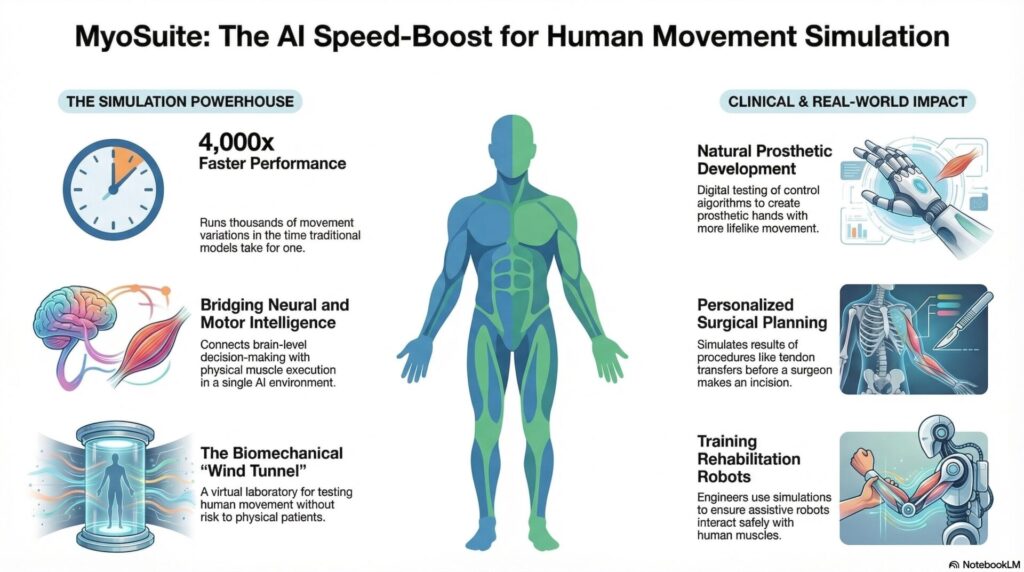
MyoSuite dramatically accelerates this process. Some simulations run up to 4,000 times faster than earlier systems.
To understand what that means, imagine testing a new prosthetic arm design:
- With older tools, researchers might simulate one scenario overnight.
- With MyoSuite, they could run thousands of variations in the same amount of time.
This acceleration is similar to how weather forecasting improved when computers became more powerful. The more simulations scientists can run, the more accurate their predictions become.
Why This Matters for Prosthetics
For people who have lost a limb, prosthetic technology has improved enormously in recent decades. However, creating prosthetic hands that move naturally is still extremely difficult.
A prosthetic device must respond to muscle signals from the body, coordinate multiple joints, and adapt to different tasks—gripping a glass, typing on a keyboard, or tying shoelaces.
MyoSuite offers a powerful testing ground for these technologies.
Researchers can simulate how a prosthetic interacts with muscles and nerves before building a physical prototype. In practice, this could mean:
- Designing prosthetic hands with more natural movement
- Testing control algorithms for robotic limbs
- Reducing development time and costs
Instead of relying only on physical experiments, engineers can explore thousands of designs digitally.
A New Era for Rehabilitation After Injury
Every year, millions of people worldwide experience strokes, spinal cord injuries, or serious muscle damage. Rehabilitation is often slow and unpredictable.
One of the biggest challenges is understanding how the body will respond to therapy or surgery.
This is where digital simulations like MyoSuite may become extremely valuable.
The platform can model biological conditions such as:
- Muscle fatigue, which affects how long muscles can sustain activity
- Sarcopenia, the age-related loss of muscle mass
- Tendon injuries, which can dramatically reduce mobility
For example, if a patient suffers a torn tendon, surgeons sometimes perform a procedure called tendon transfer, where a healthy tendon is moved to restore lost function.
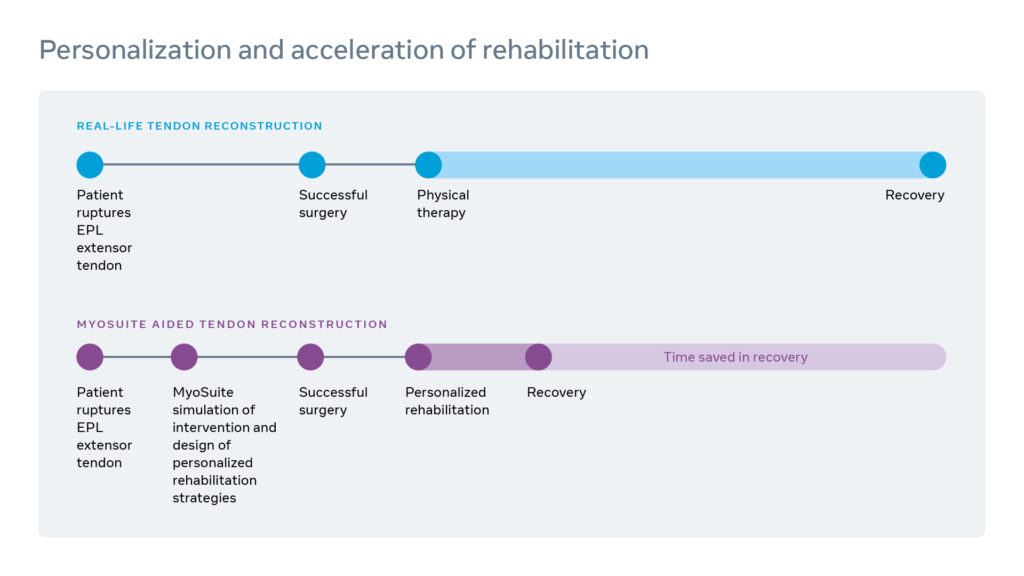
With a system like MyoSuite, researchers can simulate the results of that procedure before surgery takes place. They can also estimate how rehabilitation exercises might affect recovery.
In the future, this could lead to more personalized treatment plans—where therapy is optimized for each patient’s unique anatomy.
Training Robots to Help Humans Move
Another promising application involves rehabilitation robots.
These devices assist patients in performing repeated movements during therapy. The idea is simple: repetition helps the brain relearn motor skills after injury.
However, designing robots that interact safely and effectively with the human body is extremely complex.
MyoSuite allows engineers to simulate how assistive robots interact with muscles and joints. This means researchers can test robotic therapies digitally before deploying them in clinics.
The ultimate goal is smarter rehabilitation devices that adapt to each patient’s needs.
Think of it like having a “fitness coach” powered by AI—one that understands exactly how muscles respond during recovery.
Connecting the Brain and the Body
One of the most interesting aspects of MyoSuite is that it attempts to combine two different types of intelligence:
- Neural intelligence, which represents decisions made by the brain
- Motor intelligence, which represents how muscles execute those decisions
For decades, artificial intelligence research mostly focused on the first part—decision-making algorithms.
Biomechanics research focused on the second—how muscles and joints generate movement.
MyoSuite brings these two worlds together. The system allows AI to learn how decisions translate into real physical actions.
This approach could help scientists better understand how humans coordinate movement—and how to restore it when something goes wrong.
Unexpected Applications: From Healthcare to Virtual Worlds
Although healthcare is one of the most promising applications, MyoSuite may also influence other fields.
For example, realistic movement is essential in virtual environments. Developers working on immersive digital experiences want avatars that move like real humans.
Musculoskeletal simulations could help create virtual characters whose gestures and hand movements look more natural.
This might sound like entertainment, but the underlying research could also support medical training simulations, surgical planning tools, or physical therapy platforms.
In other words, the same technology that helps design a digital avatar might also help a patient recover mobility.
A Collaborative Effort in Science
MyoSuite emerged from collaboration between AI researchers and biomechanics experts, including scientists from the University of Twente in the Netherlands.
The platform has been released as open-source software, which means researchers around the world can use it, improve it, and build new applications on top of it.
This collaborative approach is often how major technological breakthroughs happen. When scientists share tools and data, progress tends to accelerate.
In the coming years, researchers may use MyoSuite to tackle new challenges, such as:
- Designing smarter exoskeletons
- Improving robotic surgery tools
- Understanding neurological diseases that affect movement
The Bigger Picture: A Digital Laboratory for the Human Body
If the past decade of medicine was about collecting health data, the next decade may be about simulating the human body.
Digital models could allow doctors to experiment safely before applying treatments to real patients.
It’s similar to how engineers test aircraft designs in wind tunnels before building the plane. Instead of testing directly on people, researchers can first explore possibilities in a simulated environment.
MyoSuite represents one step toward that future.
By combining artificial intelligence, biomechanics, and high-speed simulations, it offers a new way to study how humans move—and how technology might help restore movement when it’s lost.
For millions of patients recovering from injury or adapting to prosthetic devices, that future could make a profound difference.
Leave a Reply