For decades, wearable technology has been getting better at measuring our bodies.
Smartwatches count our steps, measure our heart rate and estimate how well we slept. Fitness trackers can tell us how hard we trained. Increasingly, these devices are becoming small enough to disappear into everyday life.
Now something different is happening.
Musumeci Online – The Podcast. It is perfect for driving, commuting, or waiting in line!
The next frontier of wearable technology may not be another measurement of the body. It may be the brain.
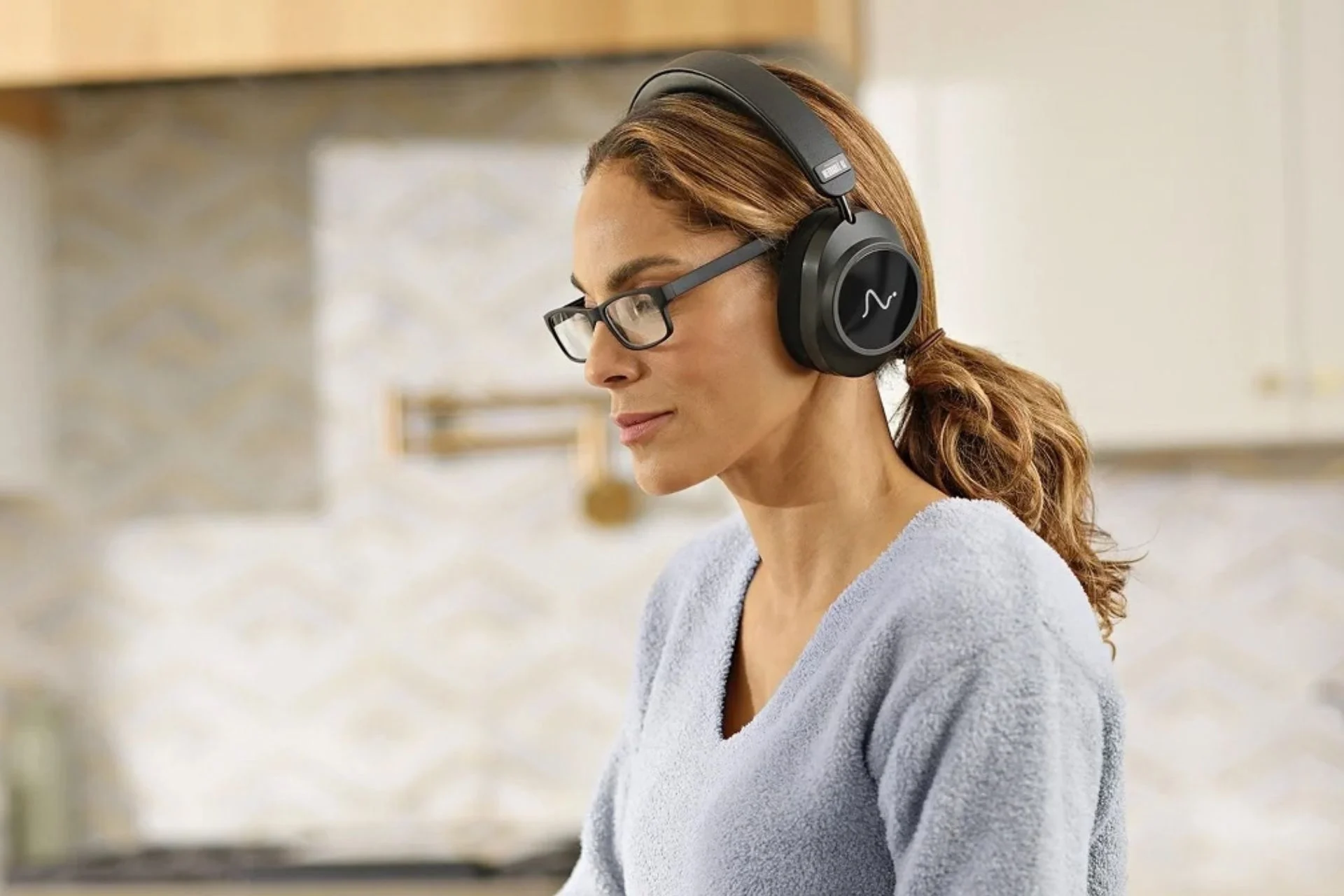
Neurable has just launched Neurable One, a pair of everyday headphones containing 12 electroencephalography (EEG) sensors designed to monitor brain activity while people work, study, meditate or simply go about their day.

At $499, they look much more like premium headphones than a medical device. And that is precisely what makes them interesting.
Because if brain-computer interfaces (BCIs) are eventually going to become part of everyday life, perhaps they will not always look like futuristic machines.
Perhaps they will look like headphones.
From measuring the body to sensing the brain
The basic idea behind Neurable One is not entirely new.
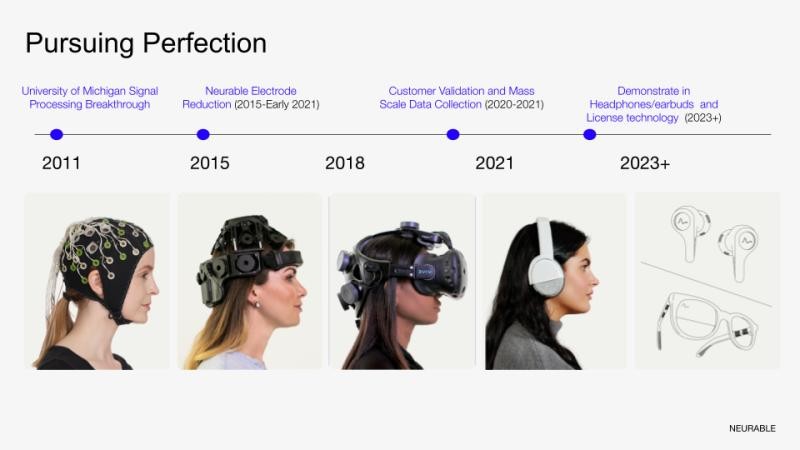
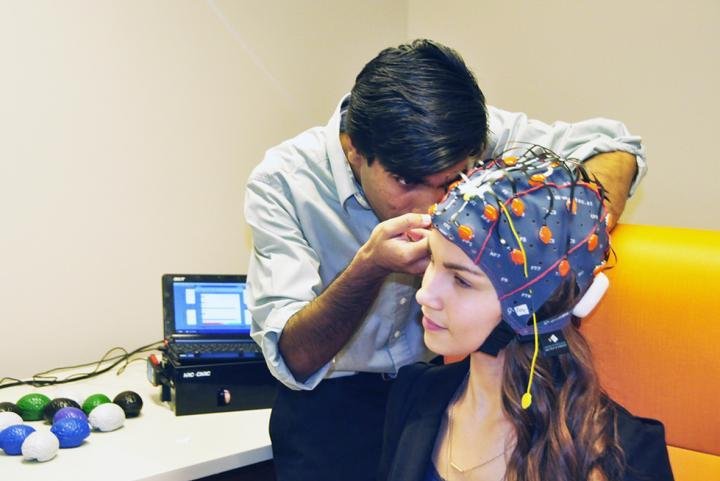
EEG has been used for about a century. An EEG records tiny electrical signals produced by the brain as networks of neurons communicate with each other. In a hospital or research laboratory, this usually means wearing a cap covered with electrodes, often with a trained professional helping to position and monitor the equipment.
The problem is that laboratories are very different from everyday life.
A person sitting still in a controlled room is relatively easy to measure. A person walking to a meeting, working at a laptop, listening to music or drinking coffee is much harder.
Movement creates noise. Electrical equipment creates interference. Even the muscles around the eyes and face can affect the signal.
Neurable’s challenge has therefore not simply been to put EEG sensors into headphones. It has been to make the brain signal useful while the person is living a normal life.
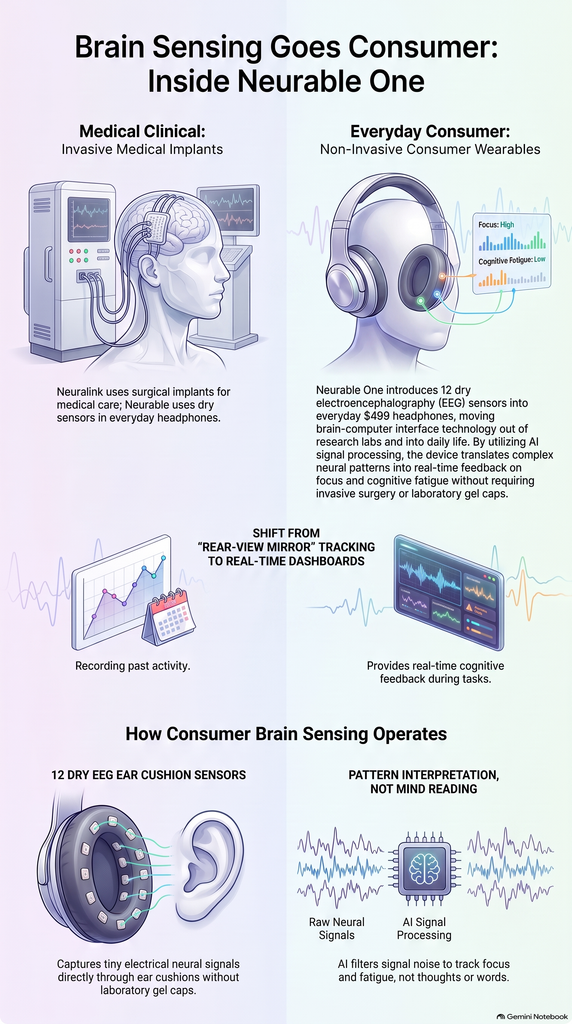
The company says it has spent around a decade developing signal-processing techniques and AI designed to separate useful neural information from the noise of everyday environments. Neurable One places 12 dry EEG sensors inside the ear cushions, where they can make contact with the user’s head without the traditional gel-filled EEG cap.
That may sound like a small engineering detail.
It isn’t.
It is the difference between a technology that requires a laboratory and one that someone might actually wear for several hours.

What is the AI actually doing?
This is where things become particularly interesting.
The sensors do not produce a simple message saying:
“You are focused.”
They record electrical signals from the brain. Those signals are complex, noisy and constantly changing.
Software then processes the EEG data and looks for patterns associated with different cognitive states.
Neurable says its system can provide information about metrics such as focus, cognitive effort, fatigue and other brain-related signals. The company stresses that the headphones do not read thoughts, words, images or mood. Instead, they interpret patterns in brain activity associated with states such as attention and fatigue, using the individual’s previous measurements as a reference.
This distinction is extremely important.
Think of it like a heart-rate monitor.
A smartwatch can tell you that your heart rate is 120 beats per minute. It can then use that information to estimate that you may be exercising.
But the watch is not “reading” what you are thinking about while you run.
EEG-based brain sensing works in a similar way. It measures physiological signals and uses algorithms to interpret patterns. It does not provide a window directly into a person’s thoughts.
The unusual part: the brain becomes a wearable data source
Neurable One can analyse brain activity at different timescales.
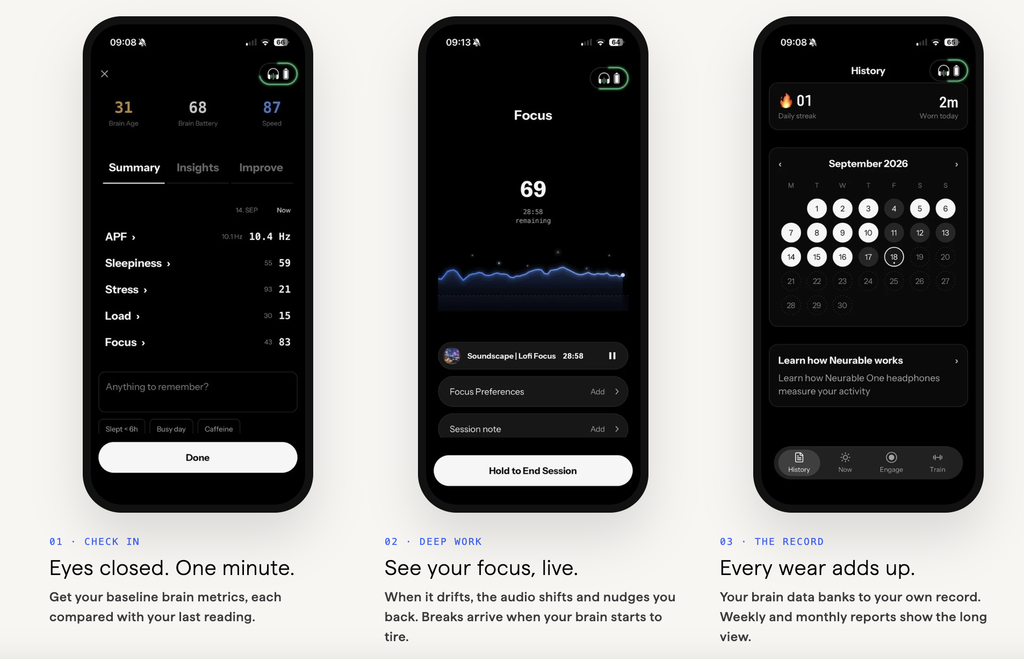
During a work session, the system can provide feedback about changes in focus and suggest a break when the signals indicate increasing fatigue. Over longer periods, the application can build a record that allows users to compare their cognitive patterns over days and weeks.
This creates a potentially important shift in the philosophy of wearable technology.
Traditional wearables often work like a rear-view mirror.
You sleep. The device records your sleep. The next morning, you look at the result.
Neurable is trying to make brain sensing more like a dashboard.
The system can potentially detect a change while it is happening and use that information to provide feedback.
That is a very different relationship between a wearable and its user.
And this is where BCI enters the story
A brain-computer interface does not necessarily mean a brain implant.
At its simplest, a BCI is a system that records brain activity, analyses it and translates relevant patterns into information or commands that a computer can use.
There are therefore very different ways of building one.
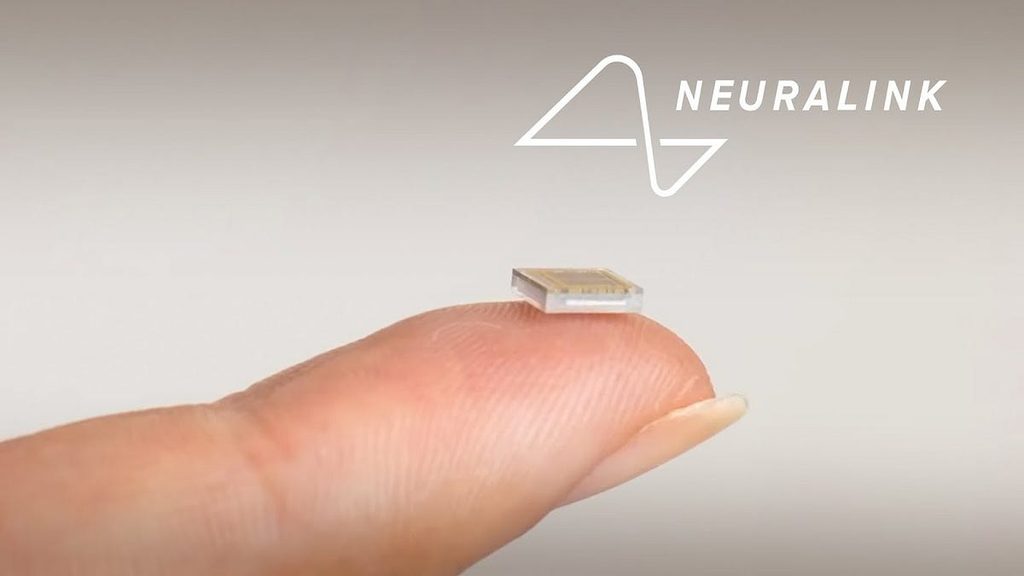
Neuralink, for example, is developing an implantable BCI. Its N1 implant records neural activity through electrodes placed inside the brain, with the goal of enabling people with severe paralysis to control digital devices. Neuralink’s current clinical programmes are investigational medical-device studies rather than consumer products.
Neurable is taking almost the opposite route.
No brain surgery.
No implanted electrodes.
No surgical robot.
Instead, the electrodes sit in the headphones and record brain activity non-invasively.
The two technologies therefore belong to the same broad BCI family, but they are solving very different problems.
Neuralink is pursuing high-resolution neural interfaces for medical applications. Neurable is trying to make non-invasive brain sensing practical enough for everyday use.
This distinction matters because the future of BCI will probably not be defined by a single technology.
There may be a spectrum ranging from consumer EEG wearables to sophisticated clinical systems and, eventually, highly precise implanted interfaces.
Could this eventually change healthcare?
This is where we need to separate today’s product from tomorrow’s possibilities.
Neurable One is explicitly positioned as a consumer wellness product, not a medical device. It is not intended to diagnose, treat or monitor a medical condition.
But the underlying technology belongs to a much broader research field.
Wearable EEG is already being investigated for applications including cognitive assessment, fatigue monitoring, epilepsy and rehabilitation. A 2026 systematic review in npj Digital Medicine analysed 21 studies involving wearable EEG for detecting mild cognitive impairment. The reported classification performance varied substantially, from 46% to 95%, highlighting both the potential of the technology and the importance of further standardisation and real-world validation.
This is a useful reality check.
Putting EEG into a comfortable pair of headphones does not automatically turn those headphones into a diagnostic tool.
Healthcare requires something much more demanding: reproducible measurements, clinically meaningful biomarkers, validated algorithms, diverse patient populations, regulatory approval and evidence that using the technology actually improves outcomes.
But if wearable EEG becomes sufficiently reliable, comfortable and affordable, it could open interesting possibilities.
Imagine neurological monitoring that does not require someone to visit a specialised laboratory every time.
Imagine rehabilitation exercises in which a system could detect whether the brain is engaging with a movement even before the movement itself becomes visible.
Imagine long-term monitoring that captures changes in brain activity during ordinary life rather than during a short appointment.
These are not promises made by Neurable One.
They are examples of why making brain sensing easier to deploy could matter for healthcare.
The most important question may not be technical
There is another issue hiding inside this technology.
What happens when brain data becomes another everyday form of personal data?
We have already become accustomed to sharing information about our heart rate, location, sleep and physical activity with digital services.
Brain activity feels different.
Neurable itself recognises this sensitivity. Its current privacy policies distinguish between raw EEG data and information derived from that data, and state that raw EEG collection requires user opt-in. The company also says it does not sell brain data or use it for advertising.
These are important safeguards, but the broader question goes beyond one company.
As brain-sensing technology becomes more common, society will have to decide how this information should be handled.
- Who owns it?
- How long should it be stored?
- Can users move it between services?
- Could employers ever want access to it?
- Could insurers be interested in it?
And perhaps most importantly: should every type of information that can be extracted from the brain automatically be treated as ordinary consumer data?
These questions are arriving before the technology has fully matured.
The real innovation may be hiding in plain sight
It is tempting to look at Neurable One and focus on the 12 EEG sensors.
But the more interesting innovation may be the attempt to make those sensors almost invisible.
The history of technology often follows the same pattern.
First, a technology is large, expensive and difficult to use.
Then engineers make it smaller.
Then they make it easier.
Eventually, it disappears into something people already use.
Computers moved from laboratories to desktops, then into pockets. Cameras moved from dedicated devices into smartphones. Heart-rate sensors moved from medical equipment into watches.
Brain sensing may now be entering a similar phase.
Neurable One does not mean that brain-computer interfaces have become mainstream medical technology. They have not.
It does suggest something more subtle: brain sensing is beginning to move from the laboratory into everyday consumer hardware.
And that could be an important step.
Because the future of neurotechnology may not arrive as one dramatic invention.
It may arrive quietly, hidden inside the devices we already wear.
Today, that device might be a pair of headphones.
Tomorrow, it could be something we have not imagined yet.
And somewhere along that journey, the boundary between wearable technology, artificial intelligence and neuroscience may become increasingly difficult to see.
That is when the really interesting questions will begin.
Leave a Reply