A quiet revolution is happening in healthcare — not inside hospitals, but inside our phones.
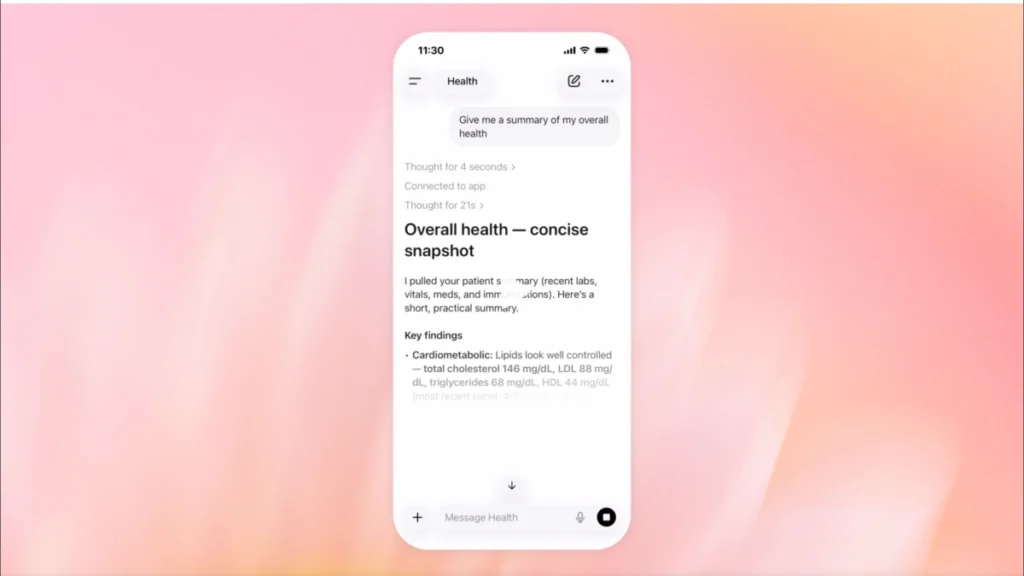
For years, people have used technology to count steps, track sleep, and Google strange symptoms at midnight. Now something more ambitious is emerging. OpenAI has introduced ChatGPT Health, a new experience inside ChatGPT designed to bring together medical records, wellness apps, and everyday health questions into a single, intelligent conversation.
It is not a robot doctor.
It is not a replacement for real physicians.
Instead, it is closer to a personal health organizer with a brain — one that can help you understand your data, prepare for doctor visits, and make sense of your health story as a whole.
Musumeci Online – The Podcast. It is perfect for driving, commuting, or waiting in line!
Why ChatGPT Health Exists
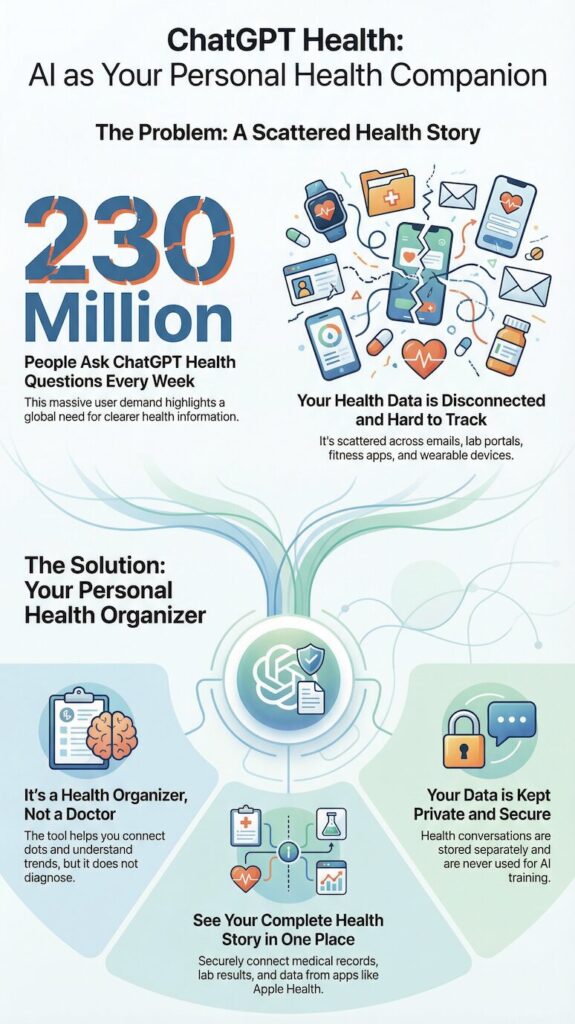
Every week, more than 230 million people around the world ask health and wellness questions using ChatGPT.
To picture that number:
That’s roughly the population of Brazil — all asking questions about sleep, stress, diets, medications, pain, and test results every seven days.
This tells us something important.
People are not just curious about technology anymore.
They are hungry for clarity in a healthcare system that often feels fragmented, rushed, and confusing.
OpenAI created ChatGPT Health to respond to this reality.
What ChatGPT Health Actually Does
Rather than offering generic answers, ChatGPT Health allows users to securely connect:
- Electronic health records (where available)
- Lab test results
- Fitness and nutrition apps
- Wearable data (such as steps and sleep)
- Wellness platforms like Apple Health and MyFitnessPal
Think of it as creating a single health diary out of dozens of scattered notebooks.
Instead of having:
- One PDF in your email
- Another report in a hospital portal
- Sleep data in a smartwatch app
- Food logs in a nutrition app
You can bring everything into one place and ask questions like:
- “Can you summarize my last blood test before my appointment?”
- “How has my sleep changed over the last three months?”
- “Does my recent fatigue match any patterns in my data?”
The system doesn’t diagnose or prescribe.
It helps you connect the dots.
A Simple Example
Imagine your health information as puzzle pieces spread across different rooms.
One piece is in your email.
Another is in your smartwatch.
Another is locked behind a hospital login.
Another is written on paper in a drawer.
ChatGPT Health does not solve the puzzle for you.
But it puts all the pieces on the same table — neatly arranged — so you and your doctor can see the full picture.
A Human Story Behind the Technology
Fidji Simo, OpenAI’s CEO of Applications, shared a personal experience that helped shape ChatGPT Health.
After being hospitalized for a kidney stone, she was prescribed a standard antibiotic. Before taking it, she checked her medical history using ChatGPT. The system flagged a dangerous interaction with a serious infection she had suffered years earlier.
That moment revealed something powerful.
Not that AI replaces doctors.
But that AI can act as a second pair of eyes when time is limited and records are scattered.
“ChatGPT Health is another step toward turning ChatGPT into a personal super-assistant that can support you with information and tools to achieve your goals across any part of your life” – Fidji Simo, CEO of applications at OpenAI
Built With Doctors, Not Against Them
ChatGPT Health was developed in close collaboration with physicians and tested using a medical benchmark called HealthBench, designed to evaluate how well AI handles realistic health scenarios.
OpenAI is explicit about three things:
- ChatGPT Health is not meant to diagnose or treat disease
- It does not replace medical professionals
- It does not train its AI models using personal health conversations
In other words, it is designed as a support tool, not a medical authority.
Privacy and Security: A Central Design Choice
Health data is among the most sensitive information people own.
ChatGPT Health therefore uses a dedicated space inside ChatGPT where:
- Health files and conversations are stored separately
- Data does not flow into other chats
- Health conversations are excluded from AI training
- Users can disconnect apps and records at any time
- Extra protections like multi-factor authentication are available
It is not governed by hospital privacy laws like HIPAA because it is a consumer app.
But OpenAI has built layered protections to reduce misuse and unauthorized access.
Why This Matters for the Future of Medicine
ChatGPT Health is not just a product.
It is part of a larger shift.
We are moving toward a world where:
- Robotic surgery improves precision
- AI detects patterns in scans faster than humans
- Smart implants monitor organs in real time
- Virtual reality helps patients recover from trauma
- Brain-computer interfaces restore movement
- Neurotechnology treats depression and paralysis
ChatGPT Health fits into this story as the translator between humans and health data.
It turns complex numbers into plain language.
It turns scattered records into meaningful narratives.
It turns isolated measurements into long-term trends.
From Episodes to a Lifelong Health Story
Most healthcare today works like a series of disconnected episodes.
You get sick.
You visit a clinic.
You leave with a report.
You forget most of it.
ChatGPT Health encourages a different mindset.
Health becomes a continuous story, not a collection of emergencies.
You can follow how your sleep, diet, stress, movement, and lab values evolve — the way you might follow chapters in a book rather than isolated pages.
Availability and What Comes Next
ChatGPT Health is currently being rolled out to a small group of early users through a waitlist.
OpenAI plans to expand access on:
- Web
- iOS
- Selected regions (with more features in the U.S. first)
Future integrations may include:
- More wearable devices
- More hospital systems
- More insurance and wellness platforms
The long-term vision is clear:
to make ChatGPT a personal super-assistant for life, not just for work or homework.
A New Kind of Health Conversation
So what is ChatGPT Health, really?
It is not a doctor.
It is not a diagnosis machine.
It is not magic.
It is something quieter and more practical.
A calm voice that helps you organize your health life.
A patient listener that remembers your patterns.
A translator that turns medical language into human language.
In a world where healthcare often feels rushed, complex, and impersonal, that alone is a meaningful step forward.
Leave a Reply