
Sometimes, the most powerful ideas don’t arrive wrapped in complexity. They arrive folded.
In a world fascinated by artificial intelligence, robotic surgery, and brain-computer interfaces, it may sound surprising that one of the most meaningful innovations in modern medicine is made largely of paper. Yet Foldscope — often called the paper microscope — reminds us that technology does not always need to be expensive or sophisticated to change lives.
Foldscope shows how creativity, curiosity, and thoughtful design can bring medical tools to places where traditional technology simply cannot reach.
Musumeci Online – The Podcast. It is perfect for driving, commuting, or waiting in line!
Why Microscopes Matter More Than We Think
To understand the impact of Foldscope, it helps to step back.
Microscopes are essential for diagnosing infections, identifying parasites, analyzing blood samples, and studying water quality. In many parts of the world, they are as important as stethoscopes. However, conventional microscopes are heavy, fragile, costly, and often require electricity and regular maintenance.
Imagine owning a car that works perfectly — but only if you have smooth roads, specialized mechanics, and a constant power supply. That is what traditional microscopes look like in remote clinics, rural schools, or field hospitals.
Foldscope was designed to solve exactly this problem.
A Simple Question That Sparked a Global Idea
The story of Foldscope began with a deceptively simple challenge:
What is the best microscope you can build for less than one dollar?
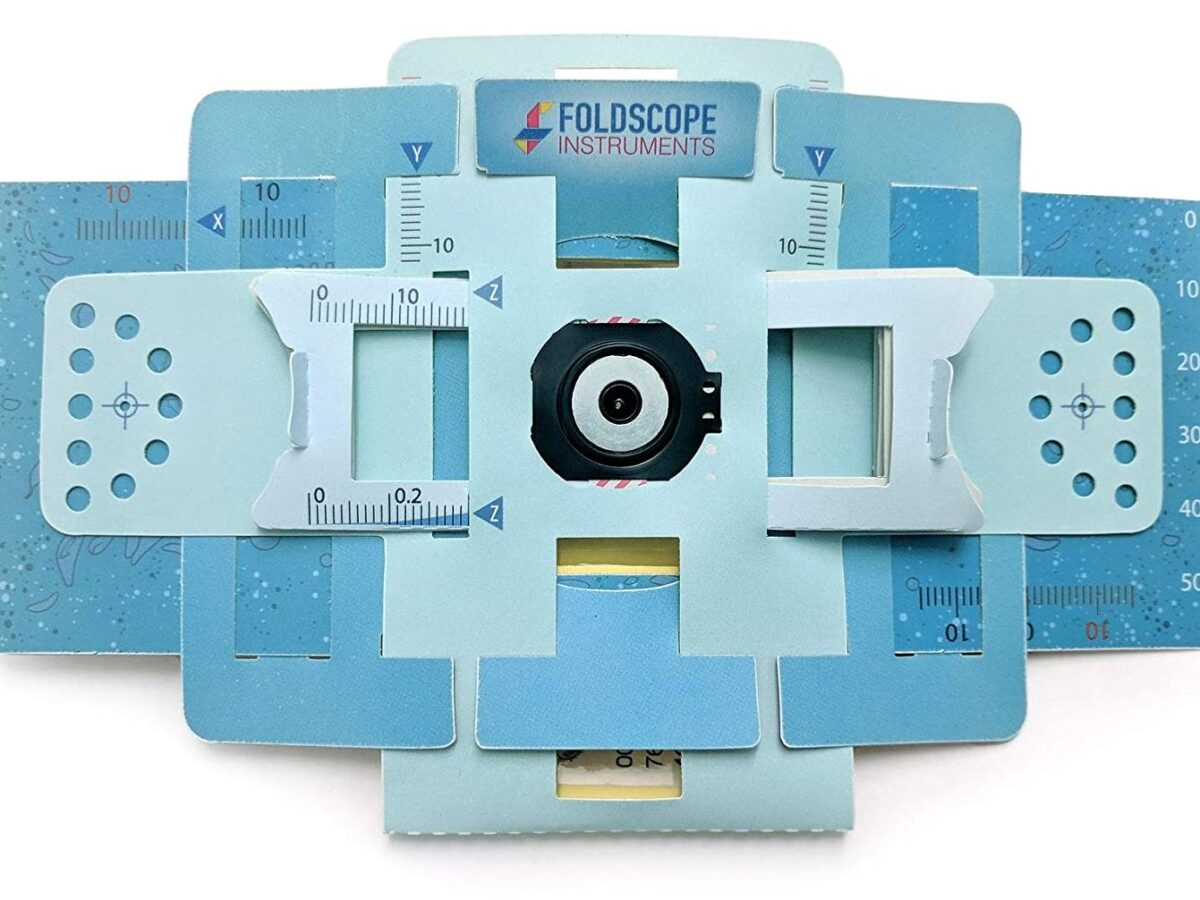
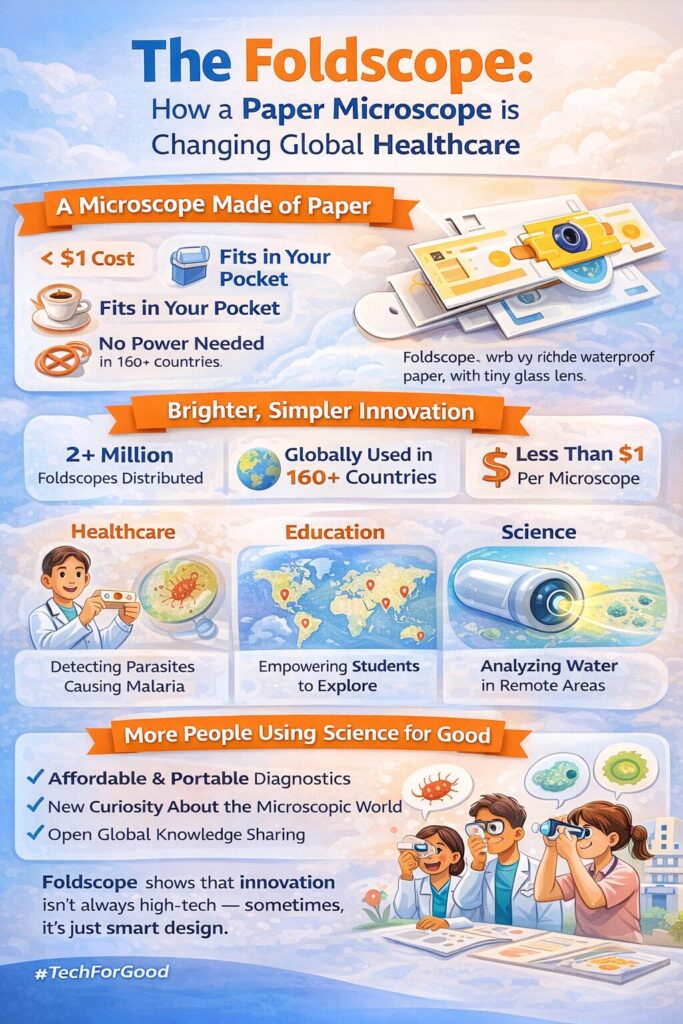
Instead of starting with advanced electronics or precision metal parts, the solution came from an unexpected place — paper. Folded in precise ways, paper can be incredibly strong, accurate, and reliable. Like origami, small changes in structure create powerful results.
The result was a fully functional optical microscope that fits in a pocket, weighs less than a coin, and can survive drops, water, and rough handling.

How Foldscope Works (Without the Technical Headache)
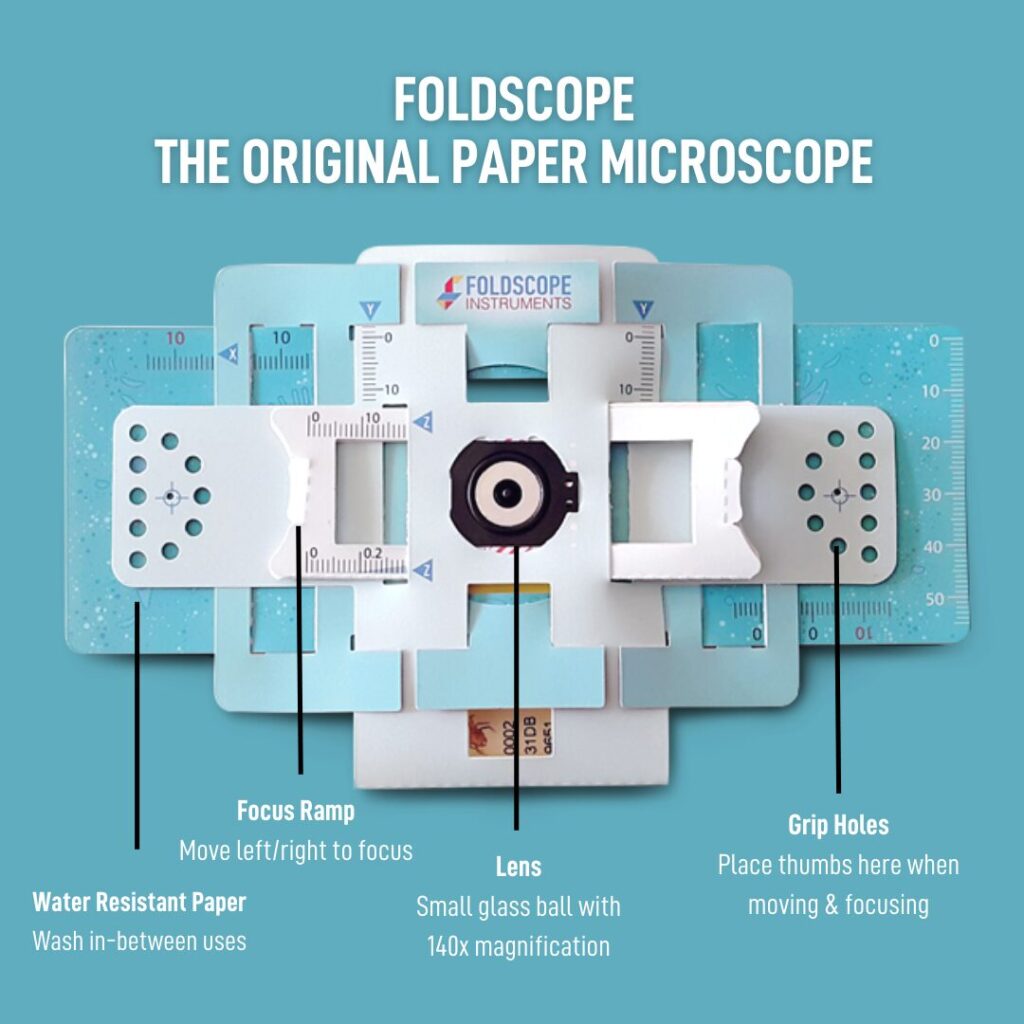
At its core, Foldscope includes:
- A tiny glass lens, roughly the size of a grain of sand
- Folded paper structures that align the optics precisely
- A simple slide for holding samples
- Natural or basic artificial light
Using it is as intuitive as reading a book: you insert a sample, point it toward a light source, and look through it.
Some versions can be paired with smartphones, allowing users to capture images or videos — turning a simple paper tool into a digital gateway for learning and diagnosis.
From Classrooms to Clinics: Real-World Use Cases
Foldscope is not just a teaching toy. Its impact spans medicine, education, and environmental science.
In healthcare, it has been used to:
- Identify parasites linked to diseases such as malaria
- Examine blood samples in low-resource clinics
- Analyze water contamination in remote communities
To put this into perspective: distributing a traditional microscope to 100 clinics might cost tens of thousands of dollars. Distributing Foldscopes to the same number of locations costs roughly the same as a family dinner.
In education, Foldscope has empowered students to explore the microscopic world themselves — pond water, pollen, insect wings — transforming science from theory into experience.
Scaling Curiosity: A Global Community of Explorers
One of the most remarkable aspects of Foldscope is not the object itself, but what grew around it.
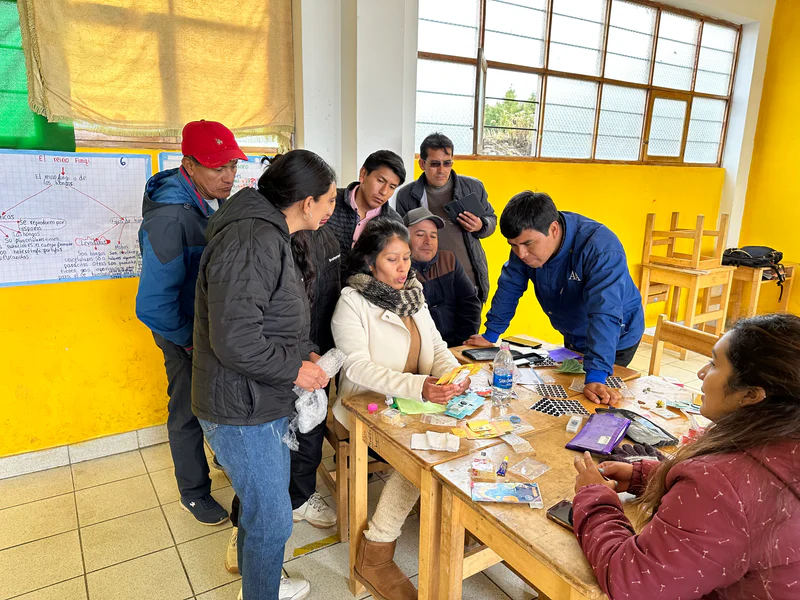
Millions of Foldscopes have been distributed globally, reaching people of different ages, cultures, and backgrounds. Users share observations, images, and discoveries through online communities, creating a living, global laboratory.
It’s similar to what happened when books became affordable: literacy exploded, ideas traveled faster, and learning became more democratic.
Foldscope is doing something similar for scientific observation.
Low-Tech Innovation in a High-Tech Medical World
At first glance, Foldscope may seem disconnected from advanced medical technologies like AI diagnostics or robotic surgery. In reality, it complements them perfectly.
Modern medicine is moving toward:
- Personalized diagnostics
- Decentralized healthcare
- Preventive screening
- Data-driven decision-making
Foldscope supports this shift by enabling early detection, local testing, and broader access to basic diagnostics — especially in places where advanced hospitals are out of reach.
Sometimes, the future of medicine is not about replacing humans with machines, but about giving more humans the right tools.
Recent Developments and Ongoing Evolution
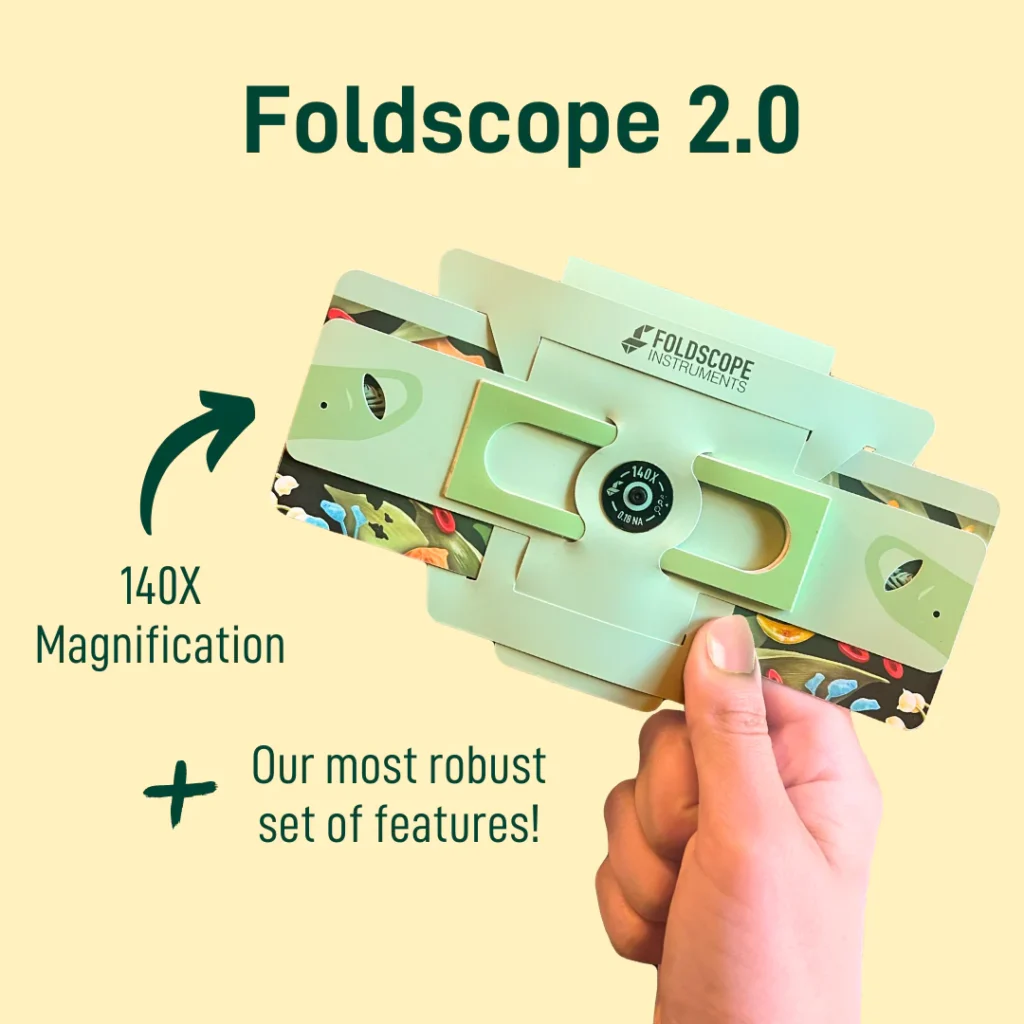
Foldscope continues to evolve. New versions have improved optics, easier assembly, and better compatibility with digital tools. Grants, awards, and global recognition have helped expand its reach even further.
What started as a laboratory experiment has become a symbol of inclusive innovation — proof that meaningful healthcare solutions can start small and grow wide.
A New Way to Think About Medical Technology
Foldscope invites a broader reflection.
When we talk about medical innovation, we often picture futuristic hospitals, robotic arms, or glowing screens. But sometimes, progress looks like a folded piece of paper in a child’s hands or a healthcare worker’s pocket.
It challenges a common assumption: that progress must always be complex, expensive, and centralized.
Instead, Foldscope reminds us that accessibility, curiosity, and thoughtful design can be just as revolutionary.
Final Thoughts: Big Impact, Small Footprint
Foldscope does not compete with advanced medical devices — it complements them. It fills the gaps, reaches the edges, and invites more people into the conversation about science and health.
In a century defined by technological acceleration, the paper microscope offers a gentle but powerful lesson:
innovation is not only about what we build, but about who gets to use it.
And sometimes, all it takes to see the invisible is a piece of paper — folded just right.
Leave a Reply